

Key Points:
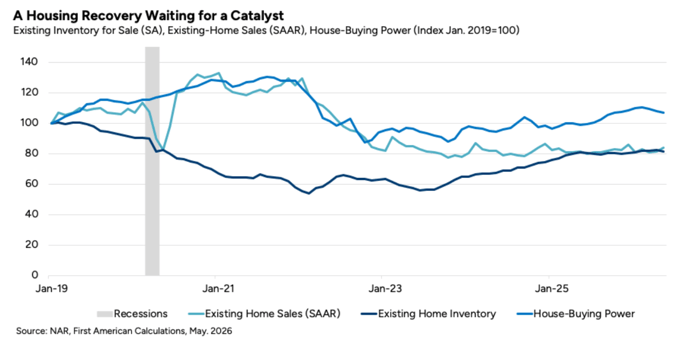
- Affordability headwinds have strengthened. Higher mortgage rates have reduced house-buying power, while slowing new listings growth and elevated uncertainty continue to weigh on existing-home sales.
- Structural tailwinds remain intact. The mortgage rate lock-in effect continues to loosen gradually, and a resilient labor market is helping sustain buyer demand and support additional housing supply.
- The recovery continues, but slowly. Existing-home sales are expected to remain relatively stable, reflecting a market that is improving incrementally, rather than accelerating.
After gaining some momentum earlier this year, the housing market lost some steam in June. Our Existing-Home Sales Outlook (EHSO) report predicts sales to remain essentially unchanged from May, though activity remains above year-ago levels. The flat monthly reading reflects a market caught between competing forces: affordability has worsened as mortgage rates have moved higher, inventory growth is moderating, and economic uncertainty continues to weigh on buyer confidence.
At the same time, structural constraints that have limited housing activity for years—particularly the mortgage rate lock-in effect—continue to ease gradually, while a resilient labor market is providing an important foundation for demand. Together, these dynamics suggest that the housing market recovery remains intact, but is likely to continue progressing at a measured pace.
“The housing market recovery persists, but it’s waiting for a catalyst to accelerate it.”
Rising Mortgage Rates Renew Affordability Pressure
Mortgage rates once again emerged as a key headwind in June. After declining earlier this year, rates moved higher during the month, reducing affordability and limiting purchasing power. House-buying power fell to its lowest level since October 2025, reversing some of the gains buyers experienced earlier in the year. Higher financing costs not only affect monthly payments, but also influence consumer confidence, encouraging many prospective buyers to delay purchasing decisions until borrowing costs become more favorable.
Supply conditions are also becoming less supportive than they were earlier in the recovery. Active inventory remains modestly higher than a year ago, providing buyers with more options and helping restore balance to the market. However, the pace of inventory growth has slowed as new listings have declined compared with a year earlier. Fewer homeowners are choosing to sell, reflecting ongoing uncertainty, as well as the continued influence of elevated mortgage rates. While inventory levels continue to improve, slower growth in new listings suggests that meaningful supply expansion may become more difficult to sustain without further improvements in market conditions.
Economic uncertainty remains another important factor weighing on housing activity. Elevated borrowing costs, evolving monetary policy expectations, and broader economic concerns have encouraged many households to remain cautious. Even buyers with the financial capacity to purchase may postpone decisions when uncertainty about future interest rates, employment, or the broader economy is elevated.
Housing Tailwinds Keep the Recovery Moving
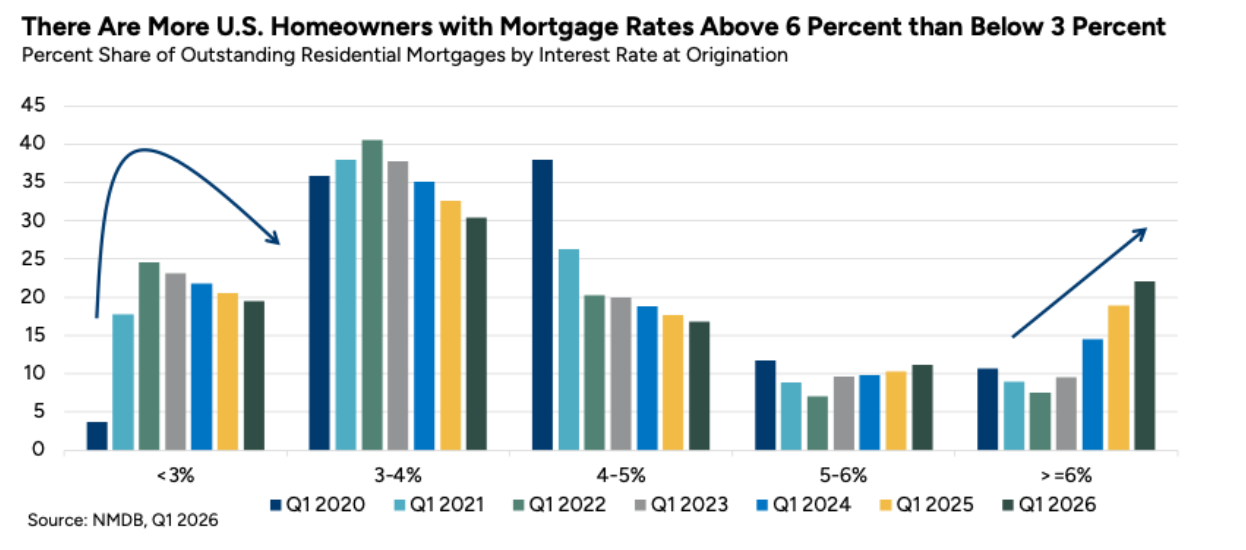
Despite these headwinds, several underlying trends continue to support a gradual recovery. The mortgage rate lock-in effect, which has discouraged many existing homeowners from listing homes because they hold mortgages well below current rates, is slowly loosening. Since the third quarter of 2025, there are more U.S. homeowners with mortgage rates above 6 percent than below 3 percent. Indeed, according to the latest first quarter 2026 National Mortgage Database (NMBD) data, about 22 percent of mortgages now carry rates at or above 6 percent, up from about 19 percent a year ago.
Meanwhile, the share with ultra-low rates below 3 percent has slipped to about 20 percent. Life events, such as job changes, family needs, and retirement, continue to bring additional homes to market, even if gradually. While the lock-in effect remains a meaningful constraint, its influence appears to be diminishing over time, allowing inventory to expand relative to the exceptionally tight conditions of recent years.
The labor market also remains an important tailwind. Stable job growth and steady wage gains continue to support household incomes and consumer confidence, giving would-be buyers greater confidence to make long-term financial commitments. Even if mortgage rates remain elevated, a resilient labor market should help sustain housing demand and limit downside risks to the market's gradual recovery.
A Recovery Waiting for a Catalyst
Looking ahead, the housing market is likely to remain characterized by gradual, rather than rapid improvement. Higher mortgage rates, reduced purchasing power, moderating inventory growth, and elevated uncertainty are expected to keep sales activity subdued in the near term. At the same time, continued loosening of the mortgage rate lock-in effect and a resilient labor market should help prevent a significant pullback in activity. Our outlook for June reflects this balance of forces, with existing-home sales expected to remain essentially unchanged from May, while holding above year-ago levels. The housing market recovery persists, but it’s waiting for a catalyst to accelerate it.
June 2026 Existing-Home Sales Outlook Highlights
For the month of June, First American updated its Existing-Home Sales Outlook Report to show that:
- Existing-home sales for June are expected to remain essentially unchanged from last month’s pace of sales, but increase nearly 5 percent compared with the pace of sales a year ago.
- The main contributors to the projected monthly increase in existing-home sales are a resilient economy (+0.4 percent) and looser credit (+0.07 percent).
Methodology
Our Existing-Home Sales Outlook Report ‘nowcasts’ existing-home sales, which include single-family homes, townhomes, condominiums, and co-ops on a seasonally adjusted annualized rate based on the historical relationship between existing-home sales, U.S. demographic trends, house-buying power, and the prevailing financial and economic conditions, as well as momentum, a weight assigned to past values. Please note that the Existing-Home Sales Outlook Report is based on assumptions about demographic, economic and financial conditions. Actual values may differ from those projected. Recent existing-home sales estimates are subject to revision to reflect the most up-to-date information available on the economy, housing market and financial conditions.