
Key Points:
- Housing affordability improved 7 percent annually in April as slower house price appreciation boosted consumer house-buying power.
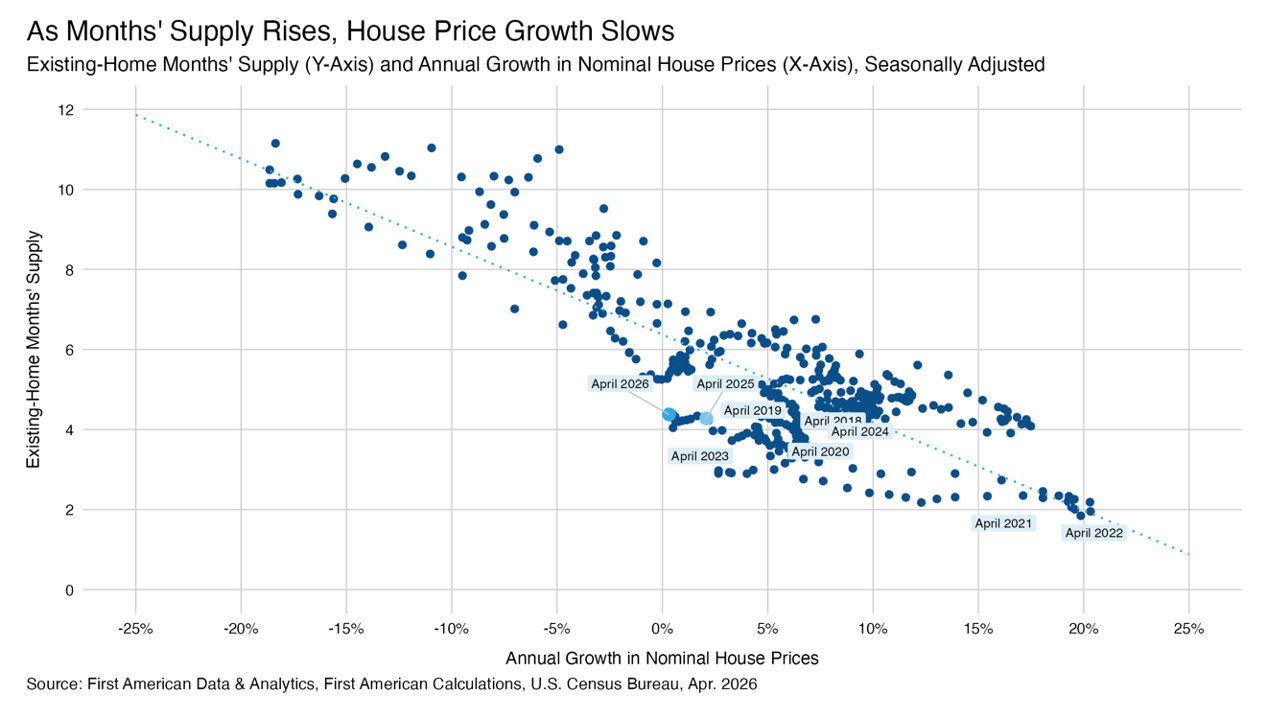
- Months' supply of existing homes increased from 3.5 months in April 2024 to 4.4 months in April 2026, helping slow annual nominal house price growth from approximately 6 percent to nearly zero.
- Generally, house price growth slows and affordability improves in markets with more months' supply relative to markets where supply remains constrained.
Housing affordability continued to improve in April, but the story is no longer just about mortgage rates or rising incomes. The housing market's gradual return to balance—with more homes for sale, less bidding competition and slower home price appreciation—is becoming an increasingly important driver of improving affordability. According to the First American Data & Analytics Real House Price Index, affordability improved 7 percent from a year ago as rising household incomes, lower mortgage rates compared with last year and moderating price growth increased consumer house-buying power.
“For now, a more balanced housing market is helping keep house price growth in check—a necessary dynamic for affordability to continue improving.”
A More Balanced Market is Slowing Price Growth
Months' supply measures how long it would take to sell the current inventory of homes at the current sales pace, assuming no new listings come onto the market. Because it reflects both the supply of homes for sale and the pace of buyer demand, it is one of the clearest indicators of whether a housing market favors buyers or sellers. When months' supply is low, sellers have more pricing power and house price appreciation tends to accelerate. As months' supply rises, buyers gain more choices, competition eases, and price appreciation typically cools. Months' supply of existing homes reached a cycle low of just 1.8 months in early 2022, just before the Federal Reserve began raising interest rates. As borrowing costs climbed, buyer demand cooled while inventory gradually recovered, pushing months' supply higher. By April 2026, months' supply had increased to 4.4 months.
As the market became more balanced, house price appreciation steadily lost momentum. Annual nominal house price growth peaked near 20 percent in early 2022 before slowing to approximately 2 percent in April 2025 and then to roughly zero today. While the pace of rebalancing has slowed over the last year, the higher level of months' supply has helped keep price growth in check. That's good news for affordability because house prices don't need to fall—they simply need to grow more slowly than household incomes.
Real Estate Remains Local
National trends tell an important story, but housing markets don't rebalance at the same pace. The relationship between months' supply, house price growth, and affordability becomes even clearer when looking across individual markets.
Generally, house price growth is slower and affordability improvement is greater in markets with more available supply. Cape Coral, Fla., for example, has more than six months' supply, house prices have declined by approximately 5 percent annually, contributing to notable affordability gains. Austin, Texas, Houston, Tampa, Fla., Orlando, Fla., and Miami tell a similar story. As inventory has accumulated relative to demand, price appreciation has slowed or turned negative, allowing household income growth and lower mortgage rates compared with a year ago to translate into meaningful affordability gains.
The opposite dynamic is evident in markets where months' supply remains constrained. In Hartford, Conn., New Haven, Conn., and Syracuse, N.Y, limited supply is still supporting house price growth strongly enough to more than offset the affordability benefit from income growth and lower mortgage rates.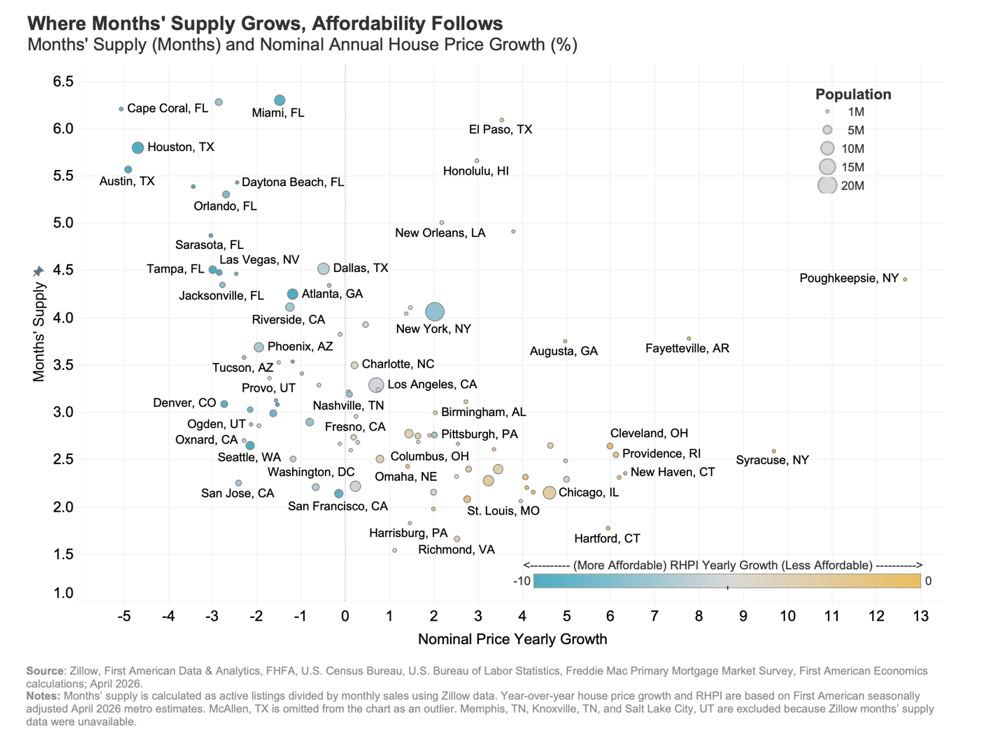
What It Means Going Forward
Over the last several years, the housing market has moved steadily toward better balance. As months' supply recovered from pandemic-era lows, house price appreciation cooled enough for household income growth to outpace it for 23 consecutive months, helping improve affordability nationally and across many local markets.
The inventory gains that characterized the last few years have slowed, but the market is operating from a much healthier starting point than it was during the pandemic housing boom. Whether affordability continues to improve will depend on how supply and demand evolve from here. For now, a more balanced housing market is helping keep house price growth in check—a necessary dynamic for affordability to continue improving.
Sources:
• First American Data & Analytics
• Freddie Mac
• Census Bureau
April 2026 Real House Price Index Highlights
The First American Data & Analytics’ Real House Price Index (RHPI) showed that in April 2026:
- Real house prices increased 1.3 percent between March 2026 and April 2026.
- Real house prices decreased 7.2 percent between April 2025 and April 2026.
- Consumer house-buying power, how much one can buy based on changes in income and mortgage rates, decreased 1.3 percent between March 2026 and April 2026, and increased 8.1 percent year over year.
- Median household income has increased 3.7 percent since April 2025 and 51.1 percent since April 2016.
- Real house prices are 28.1 percent more expensive than in January 2000.
- Unadjusted house prices are now 65.4 percent above the housing boom peak in 2006, while real, house-buying power-adjusted house prices are 9.3 percent below their 2006 housing boom peak.
April 2026 Real House Price State Highlights
- There were no states with a year-over-year increase in the RHPI.
- The five states with the greatest year-over-year decrease in the RHPI are: Georgia (-11.6 percent), New Mexico (-11.5 percent), Washington (-11.3 percent), Florida (-10.9 percent), and New York (-10.9 percent).
April 2026 Real House Price Local Market Highlights
- Among the Core Based Statistical Areas (CBSAs) tracked by First American Data & Analytics, the five markets with the greatest year-over-year increase in the RHPI are: Poughkeepsie, N.Y. (+8.1 percent), Syracuse, N.Y. (+3.3 percent), Cleveland (+3.2 percent), Fayetteville, Ark (+2.8 percent), and Albany, N.Y. (+1.3 percent).
- Among the Core Based Statistical Areas (CBSAs) tracked by First American Data & Analytics, the five markets with the greatest year-over-year decrease in the RHPI are: Tampa Fla. (-13.3 percent), Seattle (-13.0 percent), Colorado Springs, Colo. (-12.5 percent), Austin, Texas (-12.0 percent), and Atlanta (-11.6 percent).
Next Release
The next release of the First American Data & Analytics’ Real House Price Index will take place the week of July 27, 2026.
About the First American Data & Analytics’ Real House Price Index
The traditional perspective on house prices is fixated on the actual prices and the changes in those prices, which overlooks what matters to potential buyers - their purchasing power, or how much they can afford to buy. First American Data & Analytics’ proprietary Real House Price Index (RHPI) adjusts prices for purchasing power by considering how income levels and interest rates influence the amount one can borrow.
The RHPI uses a weighted repeat-sales house price index that measures the price movements of single-family residential properties by time and across geographies, adjusted for the influence of income and interest rate changes on consumer house-buying power. The index is set to equal 100 in January 2000. Changing incomes and interest rates either increase or decrease consumer house-buying power. When incomes rise and mortgage rates fall, consumer house-buying power increases, acting as a deflator of increases in the house price level. For example, if the house price index increases by three percent, but the combination of rising incomes and falling mortgage rates increase consumer buying power over the same period by two percent, then the Real House Price index only increases by 1 percent. The Real House Price Index reflects changes in house prices, but also accounts for changes in consumer house-buying power.
Disclaimer
Opinions, estimates, forecasts and other views contained in this page are those of First American’s Chief Economist, do not necessarily represent the views of First American or its management, should not be construed as indicating First American’s business prospects or expected results, and are subject to change without notice. Although the First American Economics team attempts to provide reliable, useful information, it does not guarantee that the information is accurate, current or suitable for any particular purpose. © 2026 by First American. Information from this page may be used with proper attribution.