

Key Points:
- Housing found its floor, not a springboard. The market remains subdued, but inventory, affordability, and purchase demand have all improved from a year ago.
- Demographics are proving more persistent than mortgage rates. Millennials remain in their prime home-buying years, Gen Z is entering the market, and nearly 5 million "missing" home sales point to substantial deferred demand.
- The recovery continues, but at a measured pace. Mortgage rates remain elevated, inventory normalization is slowing, and the most likely path forward remains a gradual rebalancing, rather than a boom.
A year ago, we argued that the housing market had likely found its floor and begun a slow march toward balance. Looking back, that assessment appears largely correct. The market did not rebound in dramatic fashion, but neither did it break. Existing-home sales remain subdued by historical standards, hovering near a 4 million annualized pace, yet activity has stabilized and is running above year-ago levels. Inventory has improved, affordability has edged higher, and purchase demand has shown signs of life. That progress has unfolded during a year defined by uncertainty. Artificial intelligence has become the dominant economic storyline, while geopolitical tensions in the Middle East and a new Federal Reserve chair have reshaped expectations for inflation, growth, and interest rates, often with mortgage rates moving in response.
Housing sits at the center of this storm. But, however dramatic the environment, housing ultimately responds to a familiar set of forces: jobs, incomes, demographics, supply, and financing conditions. These fundamentals remain the tide beneath the waves. The question for the second half of 2026 is whether recent shocks are changing those fundamentals. On balance, the answer remains encouraging.
“Demand did not disappear when affordability deteriorated over the last several years. It accumulated.”
The Tide Is Still Moving in Housing's Favor
If the fundamentals are the tide beneath the waves, the labor market remains an important current. For much of the past two years, concerns about housing extended beyond mortgage rates themselves to the possibility that a weakening labor market would undermine demand altogether. That deterioration has yet to materialize. Instead, labor market conditions appear to be stabilizing after a period of cooling, with several indicators suggesting labor demand may be firming and hiring broadening beyond its recent narrow base. For housing, a more stable labor market matters not only because it supports incomes, but because it supports confidence.
Household income growth continues to outpace national house-price growth, supporting modest affordability gains. That hardly solves the affordability challenge, but it does provide a foundation beneath housing demand. Recent increases in pending home sales and mortgage purchase applications suggest buyers are becoming more willing to move forward, despite elevated borrowing costs. According to our analysis of Mortgage Bankers Association seasonally adjusted purchase application data, only two of the first 25 weeks of this year recorded activity below year-ago levels.
Yet, that resilience reflects more than modest affordability improvements. The life events that drive housing demand—forming households, growing families, changing jobs, and relocating—never stopped happening. Demand did not disappear when affordability deteriorated over the last several years. It accumulated. Millennials, America's largest generation, remain firmly within their prime home-buying years, while the oldest members of Generation Z are now entering the market as first-time buyers.
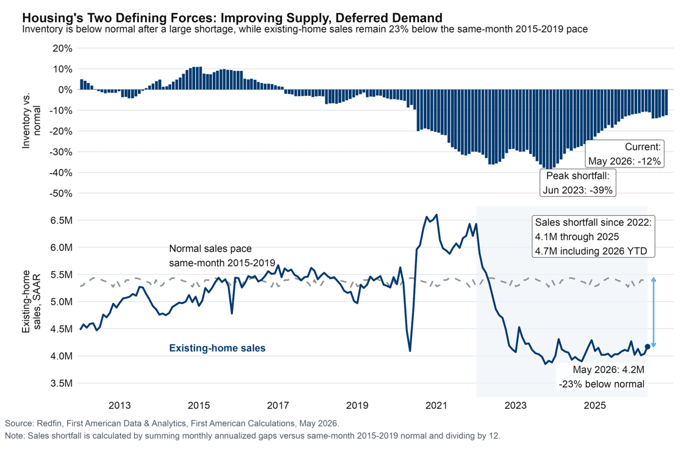
Before the pandemic, existing-home sales averaged roughly 5.4 million annually. Since 2022, activity has consistently run below that pace. Add up the difference, and the market is now short nearly 5 million home sales relative to pre-pandemic norms. The cumulative shortfall points to a significant reservoir of pent-up demand. Mortgage rates may delay household decisions, but they don't eliminate them.
Crosscurrents Remain
Mortgage rates remain the market's primary constraint. For many homeowners, moving still means exchanging a mortgage rate that begins with a three for one that begins with a six. The past several weeks offer a useful illustration of why the outlook for rates remains so uncertain. Inflation concerns pushed rates higher, only for easing geopolitical tensions to help reverse some of those gains days later. More recently, a somewhat more hawkish Fed outlook pushed long-term Treasury yields higher again. The forces shaping mortgage rates continue to pull in opposite directions. Looking beyond the day-to-day volatility, persistent inflation concerns, elevated federal deficits, increased Treasury issuance, and a more cautious Federal Reserve all suggest the path to meaningfully lower borrowing costs may be narrower than many hoped. The result is a higher-for-longer mortgage-rate environment, with plenty of zigzag along the way.
If mortgage rate uncertainty remains a key obstacle, inventory has become the primary source of relief. Rising supply has cooled competition, slowed house-price growth, and shifted some bargaining power back toward buyers, particularly across many Southern and Western markets. Nationally, inventory remains below pre-pandemic norms, but the gap has narrowed considerably—from nearly 40 percent below normal at the trough in 2023 to roughly 12 percent below normal today. The inventory recovery continues, but more slowly than before—a trend worth watching in a market still constrained by affordability and lock-in effects.
The Tide Ahead
A year ago, we argued that the housing market had begun a slow march toward balance. A year later, the destination looks much the same, even if the journey has been anything but smooth. The housing market remains constrained by elevated mortgage rates, but it is no longer defined solely by them. Demand is proving more resilient than many expected, supported by a stable labor market, favorable demographics, and years of deferred activity. Inventory has improved, giving buyers more options and helping restore some balance to the market. There will be more inflation reports, more Fed meetings, more geopolitical surprises, and more rate swings before the year is over. The waves are not going away. But housing's direction will continue to be determined by the tide beneath them. For now, that tide is still moving gradually toward balance.