
Key Points:
- A record number of single women owned homes in 2025, despite a dip in the homeownership rate.
- Long-term gains in educational attainment and real household income continue to boost women’s participation in the housing market.
- Affordability has improved to its best level since 2022, potentially supporting further homeownership growth among women.
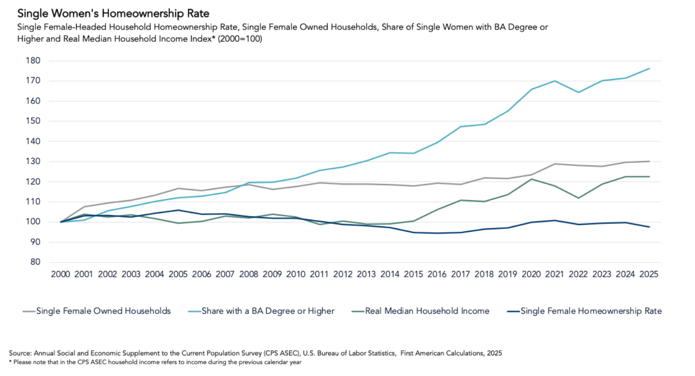
As we commemorate International Women’s Day and Women’s History Month, the latest housing data tell a nuanced but encouraging story about women and homeownership. In 2025, more than 20 million single women owned homes — the highest number on record. Yet the homeownership rate among single women edged down from 51.9 percent to 50.9 percent. At first glance, that modest decline may appear to signal a setback. A closer look reveals something different: even in a challenging affordability environment, more single women became homeowners.
The key is understanding what the homeownership rate measures. It reflects the share of households that own their home. While the number of single women homeowners increased modestly from last year, the total number of single-woman households grew even faster. Household formation among women outpaced ownership growth, resulting in a dip in the rate. In other words, the rate softened not because fewer women owned homes, but because more women formed independent households.
“…The rising number of single women homeowners underscores resilience in the face of affordability pressures and confidence in homeownership as a pathway to long-term wealth.”
Household Growth and Long-Term Fundamentals
The continued growth in single, female-headed homeowner households1 reflects broader demographic and economic shifts that have been building for years. As discussed in previous analyses, women have increasingly pursued higher education, and higher educational attainment is closely linked to stronger earnings potential and greater likelihood of homeownership. The share of single women with a bachelor’s degree or higher has risen from 20 percent in 2000 to 35 percent in 2025, expanding the pool of financially prepared buyers. Income growth has reinforced that trend. Real median household income among single women has increased from $42,000 in 2000 to $51,000 in 2025 (in 2025 dollars), improving purchasing power over time. While affordability remains strained relative to historical norms, these structural gains in education and income provide a durable foundation for homeownership.
At the same time, broader market conditions continue to weigh on buyers. Mortgage rates, though down from their recent peaks, remain elevated compared to much of the past decade. Inventory constraints persist in many markets, and home prices remain high. The overall homeownership rate also declined this year, underscoring that affordability pressures are widespread, rather than isolated to a single demographic group. Yet, even within this environment, single women increased their presence in the housing market.
Why Single Women Continue to Buy
Survey findings help explain why women continue to pursue homeownership in greater numbers. According to a recent National Association of Realtors study, single women remain a growing and influential segment of the home-buying population. They account for a larger share of purchases than single men and cite stability as a key motivation. Many report making significant financial tradeoffs — cutting discretionary spending, delaying vacations, or taking on additional work — to save for down payments and secure a home. This pattern mirrors what we observed in prior years. Despite the economic disruptions of the pandemic — often described as a “she-cession” due to its disproportionate impact on women’s employment — single women continued to pursue homeownership and build wealth through housing.
Homeownership remains one of the primary vehicles for wealth accumulation in the United States. With each mortgage payment, homeowners build equity — effectively converting monthly housing costs into long-term savings — while also benefiting from house price appreciation over time. For many households, a primary residence represents the largest single asset in their portfolio. While headline homeownership rates can fluctuate from year to year, they do not always capture the full picture beneath the surface. That wealth-building potential remains a powerful motivator, particularly for single women seeking financial stability and independence. With affordability improving to its best level since 2022, market conditions may increasingly support more women embracing the long-term commitment to building wealth through homeownership.
[1] Single-woman households refer to household heads who are separated, divorced, widowed, and never married/single.