

Key Points:
- Consumer confidence has weakened as economic uncertainty has increased, driven by rising geopolitical tensions, energy prices, and financial market volatility.
- Housing fundamentals have improved compared with a year ago, with both house-buying power and inventory improving over last year, but recent mortgage rate increases have reduced affordability at the margin.
- Demand has not disappeared—it has been delayed, as buyers remain engaged, but more hesitant, waiting for greater clarity before making purchase decisions.
Despite a modest increase in the pace of existing-home sales in February, market activity continues to hover near cycle lows, reflecting a housing market still searching for clear direction. Our Existing-Home Sales Outlook (EHSO) report indicates a slight pullback in March, just as the spring home-buying season takes shape.
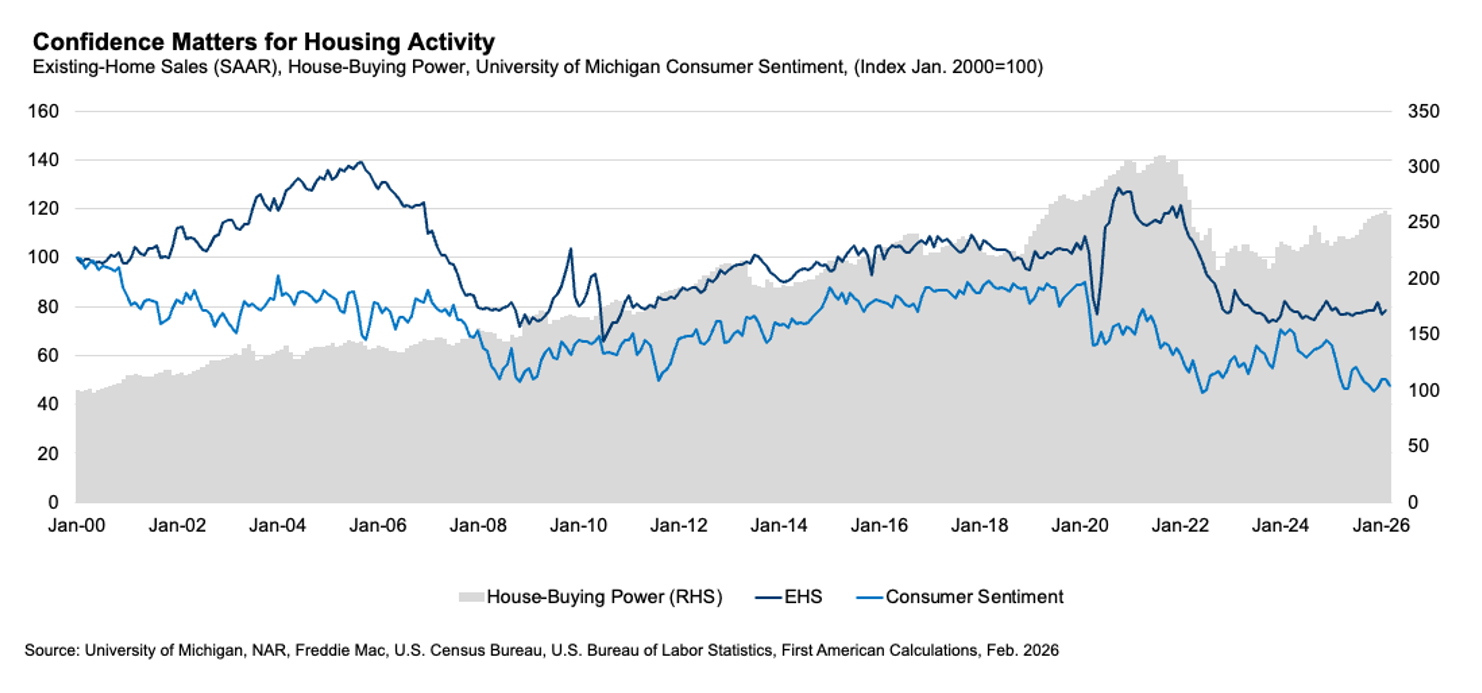
At first glance, the disconnect is puzzling. Compared with a year ago, house-buying power remains higher, and inventory has improved. Yet consumer sentiment declined in March, reversing some of the gains seen earlier this year. The question, then, is not just what buyers can do, but what they feel comfortable doing. That gap—between capacity and confidence—widens when uncertainty increases.
“In this environment, rising uncertainty does not eliminate demand, it delays it.”
Uncertainty Saps Consumer Confidence
Recent data suggest that households are navigating a more uncertain economic environment. According to the University of Michigan, consumer sentiment declined 6 percent in March, falling to its lowest level since December 2025. Much of the deterioration reflects a weaker near-term outlook: expectations for the economy over the next year fell sharply, while views on personal finances also declined. At the same time, longer-run expectations were more stable, suggesting that households may view current conditions as uncertain, but not necessarily permanent.
Several factors appear to be contributing to this shift. Rising energy prices increased financial market volatility, and heightened geopolitical tensions have all added to uncertainty in recent weeks. These developments may have also contributed to tighter financial conditions at the margin. Measures, such as the Chicago Fed’s National Financial Conditions Credit Subindex, indicate that credit conditions have moved into more restrictive territory, which can weigh on market activity.
Economists have long studied how uncertainty shapes consumer behavior. Research from the Federal Reserve Bank of Richmond shows that consumer sentiment serves as a barometer of households’ expectations about the economy and helps signal the near-term direction of spending. When sentiment weakens, it signals a more cautious outlook among households. That caution seems to already be influencing housing-related decisions, affecting whether buyers choose to act now or wait for greater clarity.
Fundamentals Remain Better Than One Year Ago
One of the most immediate ways these shifts have filtered into the housing market is through mortgage rates. Rates have increased by roughly 50 basis points over the past five weeks, driven in part by higher interest rate volatility. Earlier in the year, the mortgage rate spread narrowed, supporting affordability. As volatility has picked up, the spread has widened, putting upward pressure on mortgage rates and reversing some of those gains. As a result, house-buying power declined on a month-over-month basis in March, but remains approximately 8 percent higher than a year ago. For-sale inventory has also improved, rising 5 percent compared with last year in the first week of March and providing buyers with more options. In other words, the financial capacity to purchase a home has strengthened relative to a year ago, even as recent movements in mortgage rates have introduced near-term headwinds.
Delayed, Not Disappearing, Demand
The underlying drivers of housing demand remain firmly in place. The pre-pandemic five-year average for existing-home sales was approximately 5.4 million (SAAR). From 2022 through 2025, sales averaged closer to 4 million—millions of transactions below typical turnover. At the same time, demographic fundamentals remain supportive. Approximately 47 million Americans are in their thirties—prime home-buying years. When the economic outlook becomes less certain, even motivated buyers may choose to wait, not because the need for housing has disappeared, but because the decision feels easier to postpone until conditions become clearer. In this environment, rising uncertainty does not eliminate demand, it delays it.
March 2026 Existing-Home Sales Outlook Highlights
For the month of March, First American updated its Existing-Home Sales Outlook Report to show that:
- Existing-home sales for March are expected to decrease 0.4 percent from last month’s pace of sales, but remain 1.4 percent higher compared with the pace of sales a year ago.
- The largest contributors to the projected monthly decrease in existing-home sales are slower household formation (-0.19 percent), lower house-buying power (-0.11 percent), and tighter credit conditions (-0.04 percent).
Methodology
Our Existing-Home Sales Outlook Report ‘nowcasts’ existing-home sales, which include single-family homes, townhomes, condominiums, and co-ops on a seasonally adjusted annualized rate based on the historical relationship between existing-home sales, U.S. demographic trends, house-buying power, and the prevailing financial and economic conditions, as well as momentum, a weight assigned to past values. Please note that the Existing-Home Sales Outlook Report is based on assumptions about demographic, economic and financial conditions. Actual values may differ from those projected. Recent existing-home sales estimates are subject to revision to reflect the most up-to-date information available on the economy, housing market and financial conditions.