
Key Points:
- Housing affordability improved 11 percent year over year in February, with all top 100 markets posting gains for the first time since October 2024.
- In today’s dollars, homes are more affordable now than they were in the early 1980s because house-buying power is greater today due to lower mortgage rates and higher income levels.
- Affordability is shaped by the interaction of mortgage rates, nominal home prices and incomes, and varies significantly depending on when buyers enter the market.
Housing affordability improved meaningfully over the past year, increasing 11 percent, according to the First American Data & Analytics Real House Price Index (RHPI). Importantly, the improvement was broad-based—each of the top 100 markets we track posted year-over-year gains in affordability, the first time that has occurred since October 2024.
The improvement reflects the interaction of the three key drivers of affordability: mortgage rates, nominal home prices and household incomes. While mortgage rates remain elevated compared with recent historical averages, they are lower than a year ago. Incomes have also grown, so together income growth and lower mortgage rates boost house-buying power. Even more, nominal house prices have moderated or even declined in some markets, helping further ease affordability pressures.
“Affordability isn’t just about the price of the house, it’s about house-buying power, which in the last year increased over 12 percent.”
How Housing Affordability Compares Over Generations
Although recent trends point to improving affordability, it’s helpful to step back and view today’s conditions in a broader historical context. Housing affordability is often framed around today’s high home prices, and the February First American Data & Analytics House Price Index shows nominal prices remain near a historic high, just 0.2 percent below the peak reached in January. However, nominal house price levels alone don’t tell the full story. House-buying power, the combination of mortgage rates and income, often plays a significant role. Using the RHPI framework, we translate past housing market conditions into today’s dollars to demonstrate how affordability would differ for a buyer today if their house-buying power was the same as buyers in the past.
Using this analysis, the affordability comparison picture looks different from what many expect. The chart below shows two lines: the nominal median new-home price over time and in the price of the same home in today’s (2025) dollars after adjusting for differences house-buying power. While the median new-home price in 1981 was approximately $69,000, the house-buying-adjusted line shows that, under 1981 conditions, a home would feel like roughly $604,000 in today’s market—nearly 32 percent more than today’s median new-home price of approximately $414,000. In other words, homes were cheaper in nominal terms in 1981, but less affordable when accounting for differences in house-buying power.
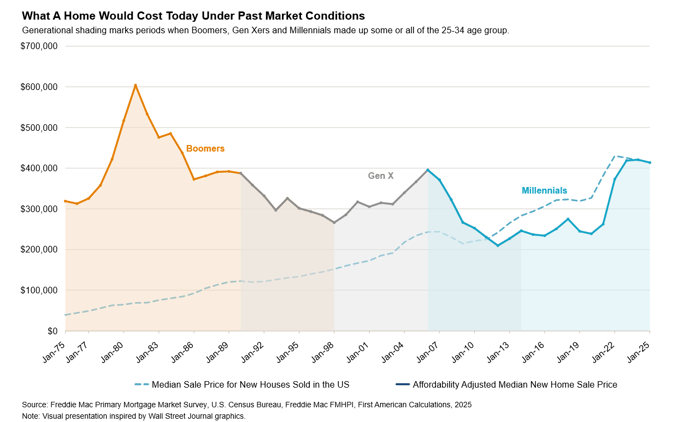
This analysis also helps explain why generations experience their home-buying journeys differently. Similar to a recent Wall Street Journal analysis using our house-buying power-adjusted median new-home sale price data, we highlight the periods when each generation made up some or all of the typical first-time home buyer age group (ages 25 to 34). For baby boomers, that spans roughly 1975 through the late 1990s. For Generation X, it runs from the early 1990s through the mid-2010s. Millennials began entering the market in the mid-2000s and continue to do so today.
Each generation faced very different housing environments. Many baby boomers entered the market in the late 1970s and early 1980s when mortgage rates peaked above 18 percent. Generation X moved through their prime home-buying years during the housing boom of the mid-2000s. Millennials largely came of age during the post-financial crisis recovery and the pandemic-era housing boom. As the chart illustrates, each generation faced a different mix of mortgage rates, income growth and nominal home prices, shaping their home-buying journeys.
What This Means for Today’s Housing Market
Recent annual improvements in affordability reflect the shifts in all three major drivers of affordability – mortgage rates, income levels and nominal house prices – moving in favor of greater affordability. Whether those gains continue will depend on how these key drivers evolve over time. Continued income growth and stable or moderating house prices can help boost affordability, while rising mortgage rates, without corresponding income gains, could reduce house-buying power. At the end of the day, affordability isn’t just about the price of the house, it’s about house-buying power, which in the last year increased over 12 percent. Keeping that broader perspective in mind is key to understanding where the market stands today and how it compares to the past.
Sources:
• First American Data & Analytics
• Freddie Mac
• Census Bureau
February 2026 Real House Price Index Highlights
The First American Data & Analytics’ Real House Price Index (RHPI) showed that in February 2026:
- Real house prices decreased 1.0 percent between January 2026 and February 2026.
- Real house prices decreased 11.0 percent between February 2025 and February 2026.
- Consumer house-buying power, how much one can buy based on changes in income and mortgage rates, increased 0.8 percent between January 2026 and February 2026, and increased 12.6 percent year over year.
- Median household income has increased 3.6 percent since February 2025 and 51.0 percent since February 2016.
- Real house prices are 24.3 percent more expensive than in January 2000.
- Unadjusted house prices are now 63.8 percent above the housing boom peak in 2006, while real, house-buying power-adjusted house prices are 12.3 percent below their 2006 housing boom peak.
February 2026 Real House Price State Highlights
- There were no states with a year-over-year increase in the RHPI.
- The five states with the greatest year-over-year decrease in the RHPI are: Georgia (-16.0 percent), Florida (-15.2 percent), Washington (-13.7 percent), Nevada (-13.7 percent), and South Carolina (-12.2 percent).
February 2026 Real House Price Local Market Highlights
- There were no states with a year-over year increase in the RHPI.
- Among the Core Based Statistical Areas (CBSAs) tracked by First American Data & Analytics, the five markets with the greatest year-over-year decrease in the RHPI are: Cape Coral, Fla. (-16.0 percent), Seattle (-15.8 percent), Sarasota, Fla. (-15.7 percent), Tampa Fla. (-15.3 percent), and Atlanta (-15.0 percent).
Next Release
The next release of the First American Data & Analytics’ Real House Price Index will take place the week of May 25, 2026.
About the First American Data & Analytics’ Real House Price Index
The traditional perspective on house prices is fixated on the actual prices and the changes in those prices, which overlooks what matters to potential buyers - their purchasing power, or how much they can afford to buy. First American Data & Analytics’ proprietary Real House Price Index (RHPI) adjusts prices for purchasing power by considering how income levels and interest rates influence the amount one can borrow.
The RHPI uses a weighted repeat-sales house price index that measures the price movements of single-family residential properties by time and across geographies, adjusted for the influence of income and interest rate changes on consumer house-buying power. The index is set to equal 100 in January 2000. Changing incomes and interest rates either increase or decrease consumer house-buying power. When incomes rise and mortgage rates fall, consumer house-buying power increases, acting as a deflator of increases in the house price level. For example, if the house price index increases by three percent, but the combination of rising incomes and falling mortgage rates increase consumer buying power over the same period by two percent, then the Real House Price index only increases by 1 percent. The Real House Price Index reflects changes in house prices, but also accounts for changes in consumer house-buying power.
Disclaimer
Opinions, estimates, forecasts and other views contained in this page are those of First American’s Chief Economist, do not necessarily represent the views of First American or its management, should not be construed as indicating First American’s business prospects or expected results, and are subject to change without notice. Although the First American Economics team attempts to provide reliable, useful information, it does not guarantee that the information is accurate, current or suitable for any particular purpose. © 2026 by First American. Information from this page may be used with proper attribution.