
Key Points:
- Existing-home sales are expected to increase modestly in April, but remain low compared with historical norms.
- Housing affordability recently improved 11 percent over the past year, with gains across all top 100 markets.
- Markets with greater affordability gains tend to show stronger sales growth, though outcomes vary based on local conditions.
Existing-home sales are expected to increase modestly in April, according to our Existing-Home Sales Outlook Report. As the spring home-buying season gets underway, the housing market is showing some signs of improvement, even as overall sales remain below historical norms.
Part of that improvement reflects a shift in affordability. Housing affordability improved meaningfully over the past year, increasing 11 percent, according to the First American Data & Analytics Real House Price Index (RHPI). Importantly, the improvement was broad-based. Each of the top 100 markets we track posted year-over-year gains in affordability, the first time that has occurred since October 2024.
This improvement reflects the interaction of the three key drivers of affordability: mortgage rates, nominal house prices, and household income. Together, these forces have increased house-buying power and expanded the range of homes within reach for many buyers. While affordability remains stretched by historical standards, even incremental gains can help support housing market activity.
“Improving affordability is supporting demand, but how that translates into sales still depends on where you look.”
From Affordability to Activity
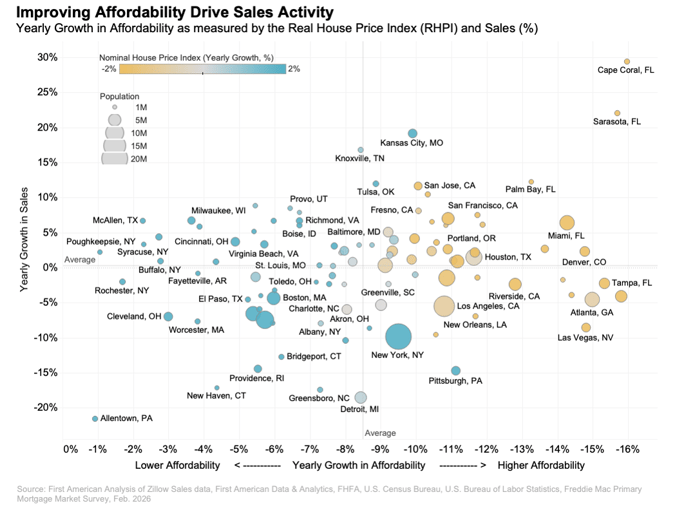
One way to see how improving affordability impacts market activity is to compare affordability trends with sales across markets heading into the spring home-buying season. Markets where affordability improved tended to see somewhat stronger sales activity, although the relationship is modest.
The chart below plots year-over-year changes in affordability against year-over-year changes in sales. Markets are also colored by house price growth, highlighting how price dynamics are shaping both affordability and activity. The vertical and horizontal lines mark the 100-market average, dividing markets based on whether affordability and sales are above or below average.
Several patterns stand out. In markets such as Cape Coral, Fla., and Sarasota, Fla., affordability has improved more significantly, increasing 16 percent in both markets, and sales have also increased more strongly. In both cases, house prices have declined, down 8 percent and 6 percent, respectively, which has helped restore purchasing power and support buyer activity.
In contrast, affordability has improved more modestly in markets such as Allentown, Pa., and New Haven, Conn., up 1 percent and 4 percent, respectively, and sales remain below year-ago levels. These outcomes illustrate how smaller gains in purchasing power may not be enough to meaningfully shift demand.
At the same time, above-average affordability gains do not always correspond to stronger sales. In markets such as Pittsburgh, Pa., and Las Vegas, affordability has improved, but sales activity remains below year-ago levels. This may reflect more cautious demand or limited inventory, suggesting that improved affordability alone does not guarantee an uptick in transactions.
Across markets, price trends play an important role in shaping these outcomes. Declining or slower price growth is generally associated with larger improvements in affordability, which in some cases is enough to bring buyers back into the market. In others, the response is more gradual, depending on local supply conditions and buyer demand. Nevertheless, taken together, the data suggest that improving affordability is beginning to support more sales activity, at least during the spring home-buying season.
What It Means for the Spring Market
As the spring home-buying season progresses, affordability will remain an important foundation for housing demand. The improvement over the past year provides support for buyers who were previously priced out. At the same time, local conditions will shape how that support translates into sales. Differences in inventory, price trends, and buyer demand will continue to drive variation across markets. Improving affordability is supporting demand, but how that translates into sales still depends on where you look.
April 2026 Existing-Home Sales Outlook Highlights
For the month of April, First American updated its Existing-Home Sales Outlook Report to show that:
- Existing-home sales for April are expected to increase 0.1 percent from last month’s pace of sales, but remain 0.9 percent lower compared with the pace of sales a year ago.
- The largest contributors to the projected monthly increase in existing-home sales are a resilient economy (+0.4 percent) and a weaker rate lock-in effect as measured by the lagged* spread between the prevailing market mortgage rate and the average rate for all outstanding mortgages (+0.1 percent).
*The spread is incorporated with a two-month lag in the Existing-Home Sales Outlook model.
Methodology
Our Existing-Home Sales Outlook Report ‘nowcasts’ existing-home sales, which include single-family homes, townhomes, condominiums, and co-ops on a seasonally adjusted annualized rate based on the historical relationship between existing-home sales, U.S. demographic trends, house-buying power, and the prevailing financial and economic conditions, as well as momentum, a weight assigned to past values. Please note that the Existing-Home Sales Outlook Report is based on assumptions about demographic, economic and financial conditions. Actual values may differ from those projected. Recent existing-home sales estimates are subject to revision to reflect the most up-to-date information available on the economy, housing market and financial conditions.