

Key Points:
- Affordability is improving as income growth outpaces home price gains.
- Inventory has improved, giving buyers more options than a year ago.
- Mortgage Rate lock-in and uncertainty will likely keep existing-home sales gains incremental in 2026.
Existing-home sales increased in November, and our latest Existing-Home Sales Outlook Report projects we’ll see another increase to end the year. This modest positive momentum suggests that the housing market is slowly thawing, although activity remains significantly below pre-pandemic levels. Several factors are working in favor of more sales activity, while others continue to hold it back. As we head into the new year, here’s the good, the bad, and what’s most likely.
“You can’t buy what’s not for sale, so cautious optimism for 2026 hinges on a rising tide of more ‘For Sale’ signs helping spur a few more sales.”
The good: affordability, inventory, and demographics are aligning
Affordability is improving, and that matters even if mortgage rates don’t fall much from here. According to our latest Real House Price Index (RHPI), affordability improved to its highest level in over three years, and the gains were widespread with affordability improving in most markets on an annual basis. House price appreciation had dipped below the pace of income growth since April 2025, which is slowly improving the monthly-payment math for would-be buyers and helping more households qualify at the margin. Affordability still isn’t ‘easy’ in absolute terms, but the trend line is supportive of more transactions.
At the same time, inventory is cooperating. In many markets, active inventory is running above year-ago levels, which is a meaningful shift after years of exceptionally tight supply. More listings expand choice, reduce buyer fatigue, and make it easier for deals to come together, especially for buyers who have been willing but unable to find a home that fits their needs and budgets.
Demographic trends represent built-in demand, so when the market gives demographic dynamics a little oxygen, the demand shows up. Many potential first-time millennial homebuyers have been waiting for conditions to improve, and even modest gains in affordability can spur that demand back into the market. If inventory continues to build, buyers who were sidelined by limited options may re-engage, helping convert pent-up demand into actual transactions. And, for households on a life-event timeline, more options can be the difference between waiting and moving.
The bad: the lock-in effect and uncertainty remain real constraints
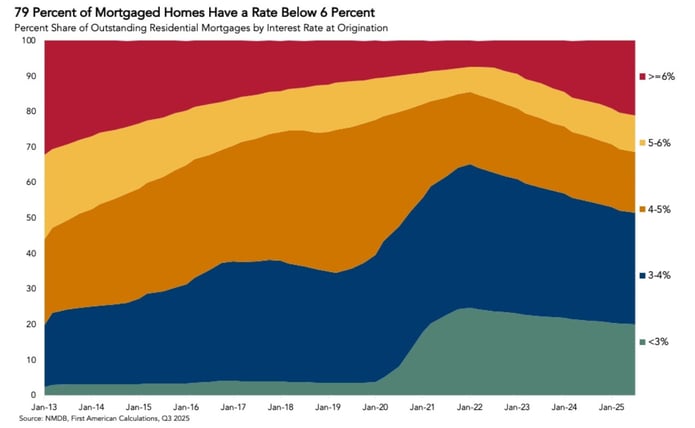
The golden handcuffs of low mortgage rates are loosening, but they’re not off. According to the latest NMBD third quarter data, roughly 79 percent of mortgaged homes still carry a rate below 6 percent, so selling often means trading a low payment for a higher one—enough to keep many ‘optional’ sellers on the sidelines and limit turnover, even as demand gradually improves. But housing decisions aren’t driven by rates alone. Moves are often prompted by life events—new jobs, new families, downsizing, retirement—and those needs can eventually outweigh the payment gap. That’s one reason the lock-in effect is gradually easing. In 2025, for the first time since 2020, the share of home buyers with rates above 6 percent exceeded the share with rates below 3 percent, reducing the market’s dependence on ultra-low-rate mortgages over time.
Uncertainty remains another headwind. Households don’t need perfect clarity to buy a home, but uncertainty around the economy, inflation, and the path of interest rates can delay big decisions—particularly when monthly payments are already elevated. According to the latest University of Michigan monthly survey of consumers, more than 60 percent of respondents expect joblessness to continue rising over the next year. That’s why existing-home sales can look like they’re gaining traction one month and stall the next -- the market responds quickly to changes in rates and sentiment, and volatility can freeze activity at the margin.
The likely: a gradual thaw, not a sudden breakout
Looking ahead, the most realistic expectation is continued, incremental progress, not a breakout. Affordability is improving because incomes are doing more of the work while home price growth stays cool, and inventory is starting to lift from historically tight levels. But elevated rates and lingering lock-in mean turnover will likely remain below what we’d consider ‘normal,’ keeping the market in a measured, stop-and-go recovery, rather than a strong rebound.
As affordability and inventory gradually improve, more life-event moves—new jobs, new families, downsizing, upsizing—should transpire, even if rates remain elevated. You can’t buy what’s not for sale, so cautious optimism for 2026 hinges on a rising tide of more ‘For Sale’ signs helping spur a few more sales.
December 2025 Existing-Home Sales Outlook Highlights
For the month of December, First American updated its Existing-Home Sales Outlook Report to show that:
- Existing-home sales for December are expected to increase 0.3 percent from last month’s pace of sales, but decrease 3.5 percent compared with the pace of sales a year ago.
- The largest contributors to the projected monthly increase in existing-home sales are a weaker rate lock-in effect as measured by the lagged* spread between the prevailing market mortgage rate and the average rate for all outstanding mortgages (+0.2 percent), higher house-buying power (+0.09 percent), and looser credit conditions (+0.02 percent).
*The spread is incorporated with a two-month lag in the Existing-Home Sales Outlook model.
Methodology
Our Existing-Home Sales Outlook Report ‘nowcasts’ existing-home sales, which include single-family homes, townhomes, condominiums, and co-ops on a seasonally adjusted annualized rate based on the historical relationship between existing-home sales, U.S. demographic trends, house-buying power, and the prevailing financial and economic conditions, as well as momentum, a weight assigned to past values. Please note that the Existing-Home Sales Outlook Report is based on assumptions about demographic, economic and financial conditions. Actual values may differ from those projected. Recent existing-home sales estimates are subject to revision to reflect the most up-to-date information available on the economy, housing market and financial conditions.