

Key Points:
- Cooling price growth has helped boost affordability to its best level since the summer of 2022.
- Months’ supply—the number of homes for sale relative to the pace of sales—is the regulator of the price ‘thermostat.’
- Across metropolitan areas, higher months’ supply aligns with cooler price growth and improving affordability.
Housing affordability improved year over year for the eighth consecutive month in October 2025, reaching its best level since the summer of 2022. While that’s a welcome milestone, affordability remains more than 64 percent below the pre-pandemic five-year average—but the trend is durably heading in the right direction. The one-two punch that did the most damage to affordability after the pandemic—rapid house price appreciation followed by a sharp run-up in mortgage rates—has lost its force. Price growth has cooled, mortgage rates have eased from their peak, and incomes have continued to climb higher.
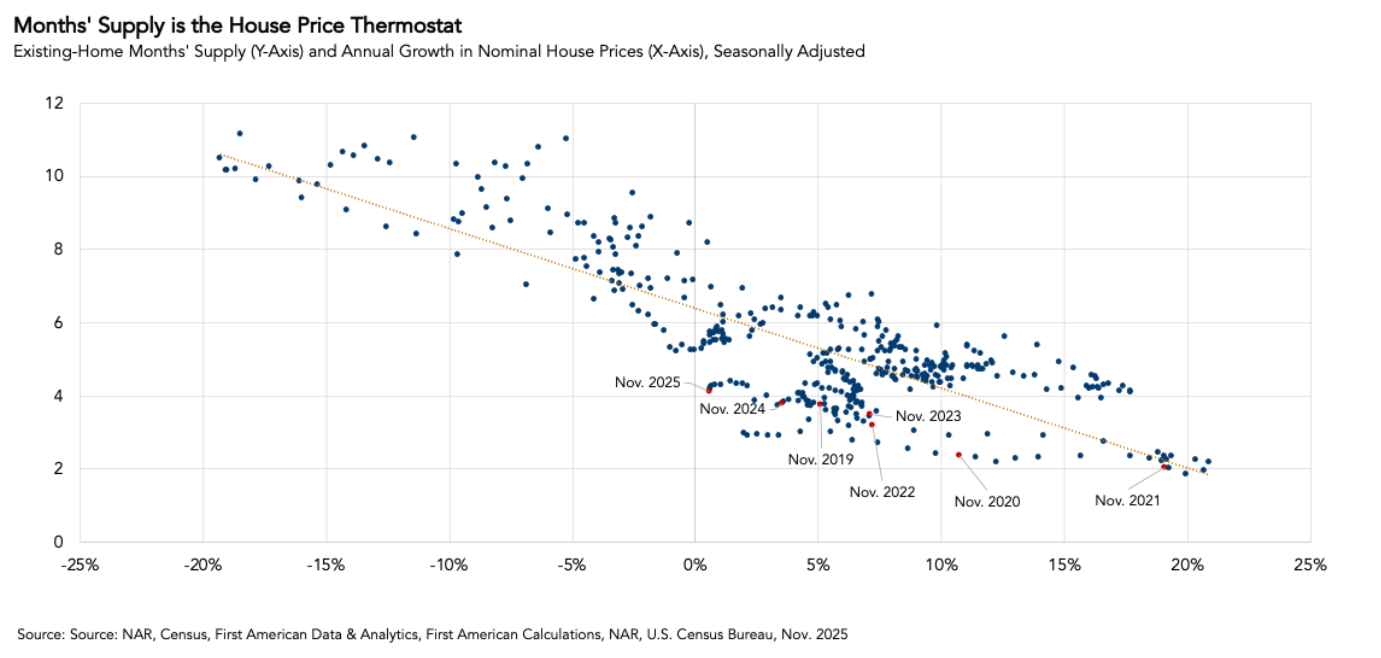
There’s an important metric that is quietly signaling the pace of house price growth right now—months’ supply, which measures the time it would take to deplete the inventory of homes for sale at the current sales rate. Months’ supply helps identify whether a market favors buyers or sellers. Generally, when months’ supply is low, competition tends to run hotter and price growth is more likely to accelerate. When months’ supply rises, the market’s “price thermostat” turns down, and price appreciation typically cools—supporting affordability.
“Keep an eye on months’ supply—it regulates temperature of house prices.”
Keep an Eye on Months’ Supply: the ‘House Price Thermostat’
During the ultra-tight conditions of November 2021, existing-home months’ supply was just above 2 months, and price growth was exceptionally strong (near 20 percent year over year). As the market gradually moved away from that extreme, months’ supply drifted higher and price growth cooled. By November 2024, months’ supply was closer to 3.8 months, and price growth had moderated to 3.5 percent. Now, in November 2025, existing-home months’ supply has ticked up to about 4.1 months and nominal house price appreciation slowed to 0.6 percent year over year.
By historical standards, four months of supply is just a little below the pre-pandemic, five-year average of 4.2 months. But, as months’ supply has moved higher from the pandemic-era tightness, price appreciation has cooled noticeably. Cooler price growth is one of the most direct ways affordability improves, all else equal.
Where Inventory Swells, House Price Growth Cools
National house price data can hide a lot of variation, so the market-level picture is especially useful. In the October 2025 market-by-market scatterplot below, each metropolitan area’s position reflects months’ supply relative to year-over-year nominal house price growth. The chart is split into four quadrants using the average months’ supply and the average price-growth rate. Metropolitan areas with higher months’ supply generally have slower price growth (top left quadrant) and markets with lower months’ supply generally have higher price growth (bottom right quadrant). The color scale adds an affordability layer, showing that markets with more months’ supply and weaker price growth are also the markets where affordability, as measured by our Real House Price Index (RHPI), tends to improve more.
Several markets illustrate that dynamic well. In places like Austin, Texas and San Antonio, months’ supply is among the highest on the chart and price growth is weak. A similar story shows up in parts of Florida. Metropolitan areas, such as Miami, Tampa, Fla. and Orlando, Fla., also have more supply and cooler, or negative, price appreciation, which helps boost affordability relative to markets where months’ supply is low and prices are still rising faster. When the local market offers buyers more options relative to the pace of purchases, the temperature of price appreciation tends to drop.
At the other end of the affordability spectrum are markets where months’ supply remains relatively low and price growth is stronger. Cincinnati, Chicago, and Cleveland stand out for hotter price appreciation with less months’ supply. Large, supply-constrained markets, such as New York and Boston, also show strong price growth with comparatively limited months’ supply. When the local market offers buyers fewer options relative to the pace of purchases, the temperature of price appreciation tends to rise.

Bottom Line
Months’ supply helps explain why price growth has cooled and why affordability has improved. Looking ahead to 2026, house price trends will depend on whether demand returns faster than new listings and new construction can add supply. If demand outpaces supply growth, months’ supply could tighten and the temperature of the price thermostat could rise, but if supply keeps pace with—or outpaces—sales, a cooler house price temperature may prevail. Keep an eye on months’ supply—it regulates the temperature of house prices.
Sources:
• First American Data & Analytics
• Freddie Mac
• Census Bureau
October 2025 Real House Price Index Highlights
The First American Data & Analytics’ Real House Price Index (RHPI) showed that in October 2025:
- Real house prices decreased 1.1 percent between September 2025 and October 2025.
- Real house prices decreased 4.2 percent between October 2024 and October 2025.
- Consumer house-buying power, how much one can buy based on changes in income and mortgage rates, increased 1.3 percent between September 2025 and October 2025, and increased 5 percent year over year.
- Median household income has increased 3.1 percent since October 2024 and 58.0 percent since January 2015.
- Real house prices are 25.9 percent more expensive than in January 2000.
- Unadjusted house prices are now 63.2 percent above the housing boom peak in 2006, while real, house-buying power-adjusted house prices are 11.8 percent below their 2006 housing boom peak.
October 2025 Real House Price State Highlights
- The five states with the greatest year-over-year increase in the RHPI are: Maine (+4.5 percent), New Hampshire (+3.4 percent), Connecticut (+2.2 percent), North Dakota (+0.9 percent), and Alaska (+0.6 percent).
- The five states with the greatest year-over-year decrease in the RHPI are: Florida (-11.5 percent), Nevada (-7.9 percent), Virginia (-7.2 percent), Texas (-7.1 percent), and Washington (-6.7 percent).
October 2025 Real House Price Local Market Highlights
- Among the Core Based Statistical Areas (CBSAs) tracked by First American Data & Analytics, the five markets with the greatest year-over-year increase in the RHPI are: Cincinnati (+6.8 percent), Cleveland (+4.7 percent), Hartford, Conn. (+4.4 percent), St. Louis, Mo. (+2.6 percent), and San Jose, Calif. (+1.7 percent).
- Among the Core Based Statistical Areas (CBSAs) tracked by First American Data & Analytics, the five markets with the greatest year-over-year decrease in the RHPI are: Miami (-16.8 percent), Tampa, Fla. (-14.0 percent), Seattle (-11.3 percent), Riverside, Calif. (-10.4 percent), and Atlanta (-10.3 percent).
Next Release
The next release of the First American Data & Analytics’ Real House Price Index will take place the week of January 26, 2026.
About the First American Data & Analytics’ Real House Price Index
The traditional perspective on house prices is fixated on the actual prices and the changes in those prices, which overlooks what matters to potential buyers - their purchasing power, or how much they can afford to buy. First American Data & Analytics’ proprietary Real House Price Index (RHPI) adjusts prices for purchasing power by considering how income levels and interest rates influence the amount one can borrow.
The RHPI uses a weighted repeat-sales house price index that measures the price movements of single-family residential properties by time and across geographies, adjusted for the influence of income and interest rate changes on consumer house-buying power. The index is set to equal 100 in January 2000. Changing incomes and interest rates either increase or decrease consumer house-buying power. When incomes rise and mortgage rates fall, consumer house-buying power increases, acting as a deflator of increases in the house price level. For example, if the house price index increases by three percent, but the combination of rising incomes and falling mortgage rates increase consumer buying power over the same period by two percent, then the Real House Price index only increases by 1 percent. The Real House Price Index reflects changes in house prices, but also accounts for changes in consumer house-buying power.
Disclaimer
Opinions, estimates, forecasts and other views contained in this page are those of First American’s Chief Economist, do not necessarily represent the views of First American or its management, should not be construed as indicating First American’s business prospects or expected results, and are subject to change without notice. Although the First American Economics team attempts to provide reliable, useful information, it does not guarantee that the information is accurate, current or suitable for any particular purpose. © 2025 by First American. Information from this page may be used with proper attribution.