

Key Points:
- In this coastal affordability matchup, stronger supply helps Seattle overcome Boston.
- Stronger permitting, fuller inventory, and slower price growth give Seattle the supply‑side advantage, widening buyer choice and giving purchasers more leverage.
- Median home prices increased by 0.4 percent in Seattle, less than half of Boston’s 0.9 percent, showing how those supply gains helped moved the affordability chains in Seattle’s favor.
As the NFL season closes with a battle between New England and Seattle, their corresponding housing markets are competing off the gridiron. Both coastal heavyweights rank among the country’s most expensive metros, where even a strong paycheck can feel stretched. Scanning the housing field in both markets shows conditions are starting to tilt in favor of local home buyers. As the numbers show, small improvements on the margin can significantly move the chains on affordability and help nudge toward a more balanced, buyer-friendly field, with one market being the decisive winner.
“In this coastal brawl of high-cost metros, the key differentiator is supply. Stronger construction activity and higher active inventory boost months’ supply in Seattle, helping block the house price growth blitz and giving buyers more time to scan the local housing field.”
A Tight First Possession on Prices and Sales
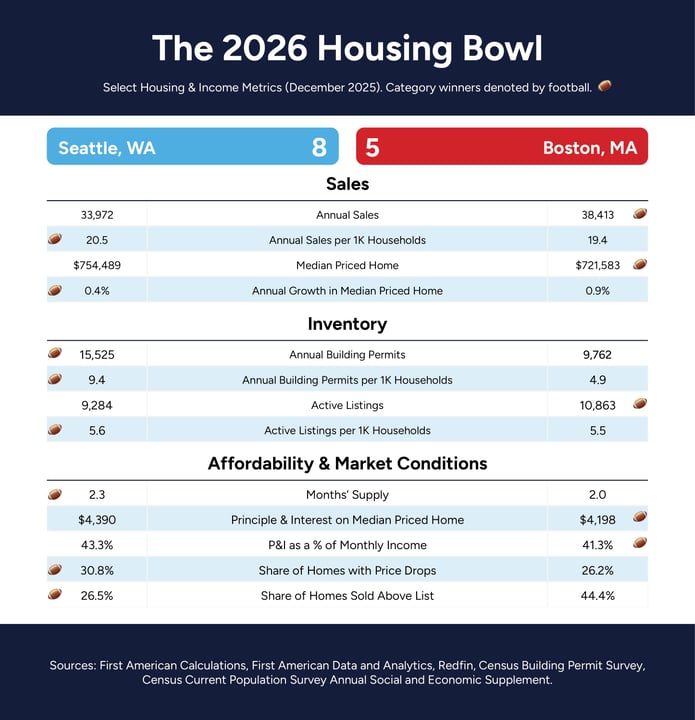
In the Housing Bowl, prices and sales set the pace of the affordability game. Boston opens with a strong start, recording 38.4 thousand home sales compared to 34 thousand in Seattle in 2025, according to analysis of Redfin data. Yet Boston is the larger market, with an estimated 2 million households compared with Seattle’s 1.7 million in 2024, based on estimates from Census Population Survey Annual Social and Economic Supplement data. After adjusting for the different market sizes, Seattle pulls ahead with 20.5 sales per 1,000 households, edging past Boston’s 19.4.
Boston’s median sale price ended 2025 at $721,500, compared with Seattle’s $754,500, according to First American Data and Analytics. The 4 percent gap in house prices doesn’t create much separation in monthly costs: with 5 percent down and a 6.2 percent mortgage rate, principal and interest payments for the median priced home are about $4,200 in Boston and $4,400 in Seattle. Compared with the national median payment of $2,100 and 30.1 percent of income, buyers in both of these markets face an affordability blitz, with payments absorbing 41.3 percent of monthly income in Boston and 43.3 percent in Seattle.
Seattle Pulls Ahead with a Solid Ground Game
After a fairly even start, the matchup begins to shift once supply enters the picture. Seattle constructed a strong ground game, issuing 15,525 building permits in the year through October, compared with 9,762 in Boston, according to the Census Building Permits Survey. Adjusted for market size, Seattle’s build rate is the real highlight, issuing an average of 9.4 permits per 1,000 households, nearly double Boston’s 4.9. Seattle’s stronger construction pipeline shows up as more supply on the housing playing field. On a market-size-adjusted basis, Seattle has slightly more inventory available, with 5.6 active listings per 1,000 households compared with 5.5 in Boston, using Redfin listings and Census household counts. Compared with pre-2020 norms, the Seattle market is also much closer to ‘full strength’ at 84.6 percent of its 2012–2019 average year-end inventory, while Boston musters just 62.3 percent, closer to fourth-and-long on supply.
Inventory Gives Seattle the Edge Downfield
Seattle’s supply push shows up in the stats that matter most for affordability. Months’ supply—the number of homes for sale relative to the pace of sales—acts like a regulator of the house price thermostat. As months’ supply rises, competition tends to ease and price growth is more likely to moderate. In Seattle, months’ supply spiked from 1.9 in December 2024 to 2.3 in December 2025, based on Redfin data. Over the same period, the seasonally adjusted median-priced home increased 0.4 percent year over year, according to First American Data and Analytics. Months’ supply in Boston also jumped, from 1.8 to 2.0, but price growth accelerated, with the seasonally adjusted median up 0.9 percent year over year—more than twice Seattle’s rate—underscoring how additional supply can help block pressure on prices.
Supply Wins the Affordability Game for Seattle
While this housing showdown doesn’t settle Sunday’s score, it’s a big win for West Coast buyers. In this coastal brawl of high-cost metros, the key differentiator is supply. Stronger construction activity and higher active inventory boost months’ supply in Seattle, helping block the house price growth blitz and giving buyers more time to scan the local housing field. Like football, housing affordability is a game of inches, and Seattle’s ground game is enough to clinch the 2026 Housing Bowl.