
Key Points:
- Existing-home sales are improving, but remain well below pre-pandemic norms.
- Sales equal just 3.3 percent of U.S. households, compared with a pre-pandemic average of 4.2 percent.
- Closing that gap would require over one million additional sales at today’s household base, underscoring just how far the market still has to go.
Existing-home sales are showing early signs of life to start the new year. Our latest Existing-Home Sales Outlook (EHSO) report points to a projected increase in sales activity in January, extending the modest momentum that emerged toward the end of last year. After a prolonged period of historically low turnover, even this modest improvement is welcome.
But improvement should not be confused with a return to normal. While sales are edging higher, activity remains well below pre-pandemic levels—and below what the market’s underlying fundamentals would suggest. As the housing market slowly recovers, the more important question is not whether sales are rising month to month, but how far we still are from something resembling balance. And that brings us to a deeper issue: what does ‘normal’ actually mean in today’s housing market?
“The housing market is moving in the right direction, but we are still far from where a market of this size and demand should be.”
Why Comparing Sales the Old Way Can be Misleading
Housing activity is often evaluated by comparing today’s sales totals to those from years past. But raw sales counts can be misleading when the market itself has grown. The total number of U.S. households, which represents the demand for shelter, has steadily increased over time. In 2025, there were 135 million households, compared with 118 million households fifteen years ago, an increase of roughly 15 percent. So, an annual pace of 4 million existing-home sales today represents considerably less activity, relative to demand, than fifteen years ago.
A more informative way to assess market activity is to scale sales to the size of the market itself. When existing-home sales are measured as a share of total households, the depth of the recent slowdown becomes clearer. In December 2025, the pace of existing-home sales was 3.3 percent of U.S. households1, or roughly three sales per 100 households. While that is the highest pace since early 2024, it’s well below the pre-pandemic average of 4.2 percent. If existing-home sales were tracking that long-run average today, the seasonally adjusted annual pace would be approximately 5.6 million annualized sales. Instead, annualized sales are 4.4 million, a 1.25 million gap in existing-home sales that helps explain why the market still feels constrained, even as monthly data show improvement.
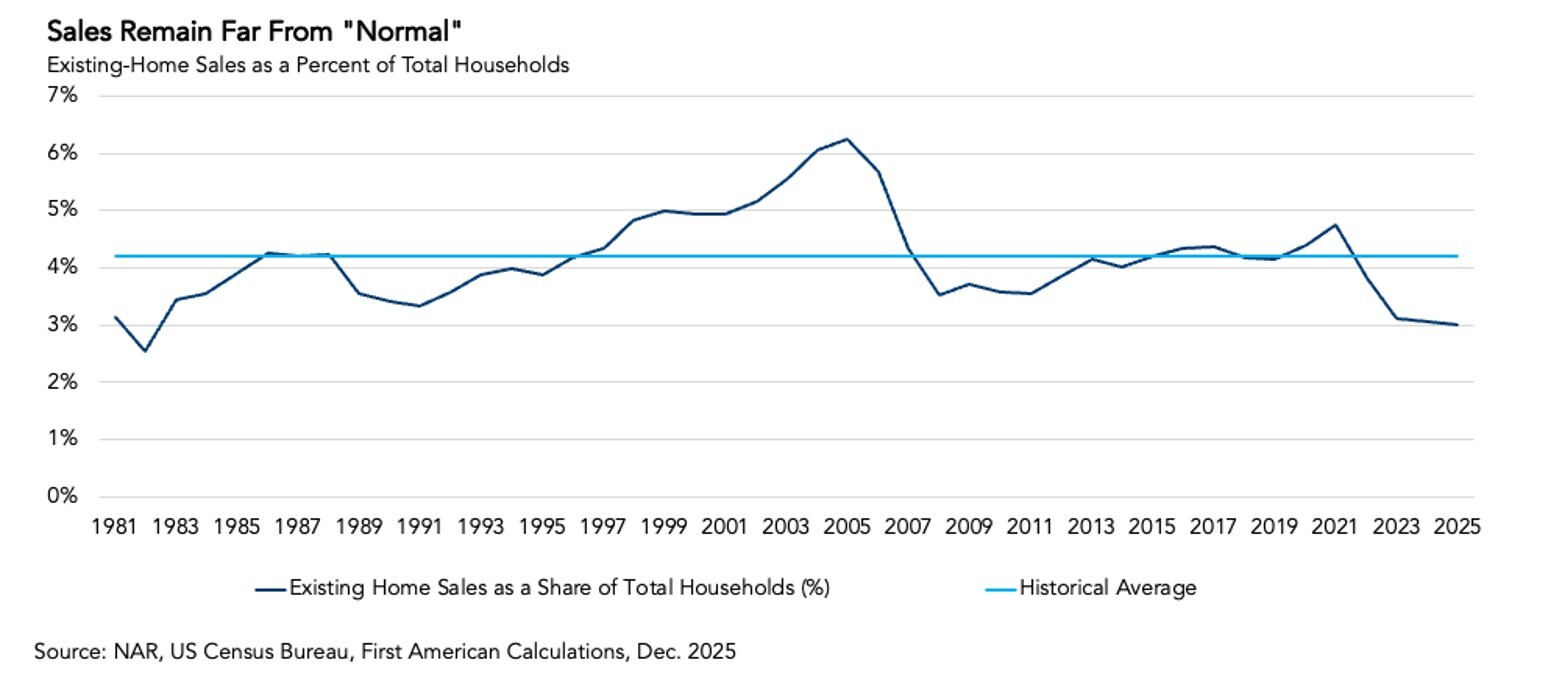
Another way to frame the shortfall is relative to recent history. If existing-home sales had continued at their 5-year, pre-pandemic average pace of 5.4 million per year, the market would have had about 4 million more sales over 2022–2025 than actually occurred. That represents a meaningful amount of buyer and seller activity that never happened. Sales activity remains below average primarily because existing homeowners are not moving. Many are rate-locked into mortgages with rates well below today’s levels or are older and choosing to age in place. In many cases, it is both. Additionally, affordability challenges and economic uncertainty concerns for first-time buyers remain real, keeping potential first-time buyers on the sidelines.
Recovering, but Not Yet Normal
The housing market is recovering, but we are still far from where a market of this size and demand should be. Instead, it reflects a market that is loosening after an extended period of constraint. A more durable recovery in sales activity is likely to come gradually, as time and life events begin to outweigh financial inertia. Job changes, family transitions, downsizing, retirement, and relocation will continue to bring homes to market, even if mortgage rates remain elevated. Indeed, 47 million Americans are in their thirties, and many still rent, representing a large pool of potential first-time buyers that may trickle into the market as life stages slowly line up with housing needs.
January 2026 Existing-Home Sales Outlook Highlights
For the month of January, First American updated its Existing-Home Sales Outlook Report to show that:
- Existing-home sales for January are expected to increase 0.7 percent from last month’s pace of sales, and increase 7.1 percent compared with the pace of sales a year ago.
- The largest contributors to the projected monthly increase in existing-home sales are a resilient economy (+0.5 percent), a weaker rate lock-in effect as measured by the lagged* spread between the prevailing market mortgage rate and the average rate for all outstanding mortgages (+0.05 percent), looser credit conditions (+0.03 percent), and rising house-buying power (+0.02 percent).
*The spread is incorporated with a two-month lag in the Existing-Home Sales Outlook model.
Methodology
Our Existing-Home Sales Outlook Report ‘nowcasts’ existing-home sales, which include single-family homes, townhomes, condominiums, and co-ops on a seasonally adjusted annualized rate based on the historical relationship between existing-home sales, U.S. demographic trends, house-buying power, and the prevailing financial and economic conditions, as well as momentum, a weight assigned to past values. Please note that the Existing-Home Sales Outlook Report is based on assumptions about demographic, economic and financial conditions. Actual values may differ from those projected. Recent existing-home sales estimates are subject to revision to reflect the most up-to-date information available on the economy, housing market and financial conditions.
[1] Households for October–December 2025 are projected by applying September’s month over month growth rate to each subsequent month.