

Key Points:
- Mortgage rate lock-in remains a major constraint, but it is no longer tightening.
- Home sales are recovering faster in states where lock-in has eased more.
- Life events—not lower rates alone—are gradually restoring housing market turnover.
Existing-home sales increased in October, and our latest Existing-Home Sales Outlook Report projects we’ll see another increase in November. The modest positive momentum suggests that the housing market is beginning a very slow thaw, although activity remains significantly below pre-pandemic levels. Several factors are helping warm up today’s housing market, including the loosening of one of the primary forces that has dampened activity since 2022: mortgage rate lock-in.
“In a housing market frozen in place for years, even a small gift—slightly looser rate lock-in—can help warm up housing activity.”
Mortgage Rate Lock-In Loosens Its Grip
In the housing market, the seller and the buyer are often the same person: the existing homeowner. To buy a home, you typically need to sell the home you already own. Most current homeowners either purchased their homes during the ultra-low mortgage rate years of 2020 through early 2022 or refinanced into historically low rates during that period. When mortgage rates doubled in less than a year, many homeowners became effectively “rate-locked” into their homes.
Why sell a home financed with a 3- or 4-percent mortgage rate and take on a new loan at a much higher rate? Doing so would increase monthly housing costs substantially. Historically, existing-home sales have accounted for nearly 90 percent of all home sales and inventory. When a large share of homeowners chooses not to sell, housing market activity slows dramatically.
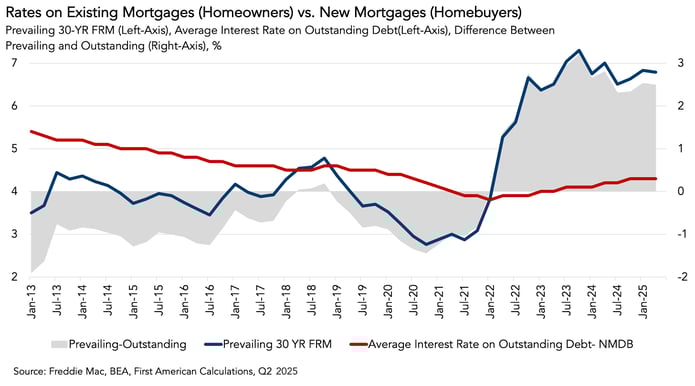
One way to measure the rate lock-in effect is by comparing the average mortgage rate on outstanding debt—what existing homeowners are paying—to the prevailing mortgage rate faced by new buyers. By this measure, the lock-in effect peaked in late 2023 and has eased since. Mortgage rates have moved lower from their highs, and a growing share of homeowners now hold mortgages originated at higher rates than those seen during the pandemic period. The result is a narrowing gap between existing and prevailing rates.
That gap remains meaningful, and lock-in continues to suppress housing market activity. But it is no longer tightening. Instead, it is gradually loosening, creating room for a modest increase in resale activity even in a higher-rate environment.
Why the Thaw Looks Different Across States
At the national level, the loosening of rate lock-in helps explain why existing-home sales have shown signs of stabilization and modest improvement, even though activity remains well below pre-pandemic norms. Over time, as life events outweigh financing considerations and trigger more home sales, the number of homeowners with ultra-low mortgage rates declines. State-level data help illustrate just how uneven this process has been.
To assess how mortgage rate lock-in and home sales recovery varies across states, we compared the state-level average mortgage rate on outstanding debt during the pre-pandemic period (2017 through 2019) with rates in the second quarter of 2025. This rate difference is compared to the difference in home sales volume between the same periods . The relationship is clear: states where mortgage rates on outstanding debt remain furthest from their pre-pandemic norms have seen the weakest recovery in home sales.
In states such as Hawaii and California, mortgage rates on outstanding debt remain far below their pre-pandemic averages, reflecting a high concentration of homeowners who locked in exceptionally low rates. In these markets, sales activity remains well below historical norms. High home prices and larger mortgage balances amplify the lock in effect, reinforcing the incentive to stay put. By contrast, states such as South Dakota and Arkansas exhibit much less evidence of binding lock-in. Mortgage rates in these states have moved closer to their pre-pandemic averages, and home sales have recovered more fully.

A Small Gift, but a Meaningful One
Mortgage rate lock-in remains a powerful constraint on housing market activity, and it will continue to limit potential sellers in the near term. But the evidence increasingly suggests that its grip is loosening—not all at once, and not everywhere, but enough to matter. And, in a housing market frozen in place for years, even a small gift—slightly looser rate lock-in—can help warm up housing activity.
November 2025 Existing-Home Sales Outlook Highlights
For the month of November, First American updated its Existing-Home Sales Outlook Report to show that:
- Existing-home sales for November are expected to increase 1.3 percent from last month’s pace of sales, but decrease 0.4 percent compared with the pace of sales a year ago.
- The largest contributors to the projected monthly increase in existing-home sales are a weaker rate lock-in effect as measured by the lagged* spread between the prevailing market mortgage rate and the average rate for all outstanding mortgages (+0.4 percent), a resilient economy (+0.3 percent), and higher house-buying power (+0.05 percent).
*The spread is incorporated with a two-month lag in the Existing-Home Sales Outlook model.
Methodology
Our Existing-Home Sales Outlook Report ‘nowcasts’ existing-home sales, which include single-family homes, townhomes, condominiums, and co-ops on a seasonally adjusted annualized rate based on the historical relationship between existing-home sales, U.S. demographic trends, house-buying power, and the prevailing financial and economic conditions, as well as momentum, a weight assigned to past values. Please note that the Existing-Home Sales Outlook Report is based on assumptions about demographic, economic and financial conditions. Actual values may differ from those projected. Recent existing-home sales estimates are subject to revision to reflect the most up-to-date information available on the economy, housing market and financial conditions.