

Key Points:
- Income gains and lower mortgage rates boosted house-buying power by roughly $36,600 year-over-year in November.
- Nominal price growth has slowed to near-zero, and 47 of 50 major metros posted affordability improvements.
- Inventory is the decisive wild card — if inventory levels don’t deteriorate dramatically, house price growth will remain in check.
Housing affordability improved year over year for the ninth consecutive month in November 2025, reaching its strongest level since the summer of 2022. While affordability is still more than 63 percent below its pre-pandemic, five-year average, the improvement trend has become increasingly clear—and increasingly durable.
The forces that crushed affordability after the pandemic have meaningfully weakened. House price growth has fallen to near zero, mortgage rates are no longer climbing, and household incomes have continued to rise. Together, these shifts have powered the consistent improvement throughout 2025, especially more recently.
“Gradual life event-driven market re-engagement should support more inventory and more sales transactions.”
Why is Affordability Improving?
In November, the labor market continued to provide critical support for housing affordability. Annual private-sector hourly wage growth increased 3.6 percent compared with a year earlier, boosting median household income by 3.5 percent year over year. Just that income growth alone increased house-buying power by roughly $13,100.
Mortgage rates fueled another significant boost. Rates were 0.57 percentage points lower than a year earlier, lifting purchasing power by approximately $23,500. Combined, higher incomes and lower rates mean home buyers have about $36,600 more house-buying power compared with November 2024.
At the same time, house price appreciation has nearly flatlined. Nominal house prices nationally barely moved, increasing just 0.5 percent annually in November, down from 3.6 percent one year earlier and marking the slowest pace since 2012. For the eighth consecutive month, income growth outpaced house price growth, steadily increasing affordability.
The dynamics fueling the improving affordability are benefitting home buyers in markets across the country. Forty-seven of the 50 major metro areas we track posted year-over-year affordability gains in November, underscoring that the improvement is broad-based, rather than localized.
Will Affordability Continue to Improve?
Looking ahead, the outlook for affordability will depend on whether today’s favorable dynamics persist. Wage growth is expected to remain positive, even as a cooling labor market could temper its pace. Mortgage rates, according to consensus forecasts, are likely to remain about the same this year. That places the spotlight on house price growth—and, by extension, housing supply.
During the 2021 -2022 period of rapid, double-digit price appreciation—when annual gains approached or exceeded 20 percent—inventory levels were more than 50 percent below what would be considered normal. Extreme scarcity amplified competition and pushed prices sharply higher. Today, inventory has improved but remains below the historically normal level . The chart below compares monthly inventory levels with the average for the same month during the more balanced 2015–2019 period. The closer the series is to zero, the closer inventory is to normal. While inventory gaps have narrowed significantly from pandemic-era extremes, the most recent increase in scarcity raises an important caution flag. If the improvement in inventory stalls or reverses course, upward pressure on house price growth may re-ignite. Even with supportive income growth and stable rates, limited supply can constrain affordability gains.
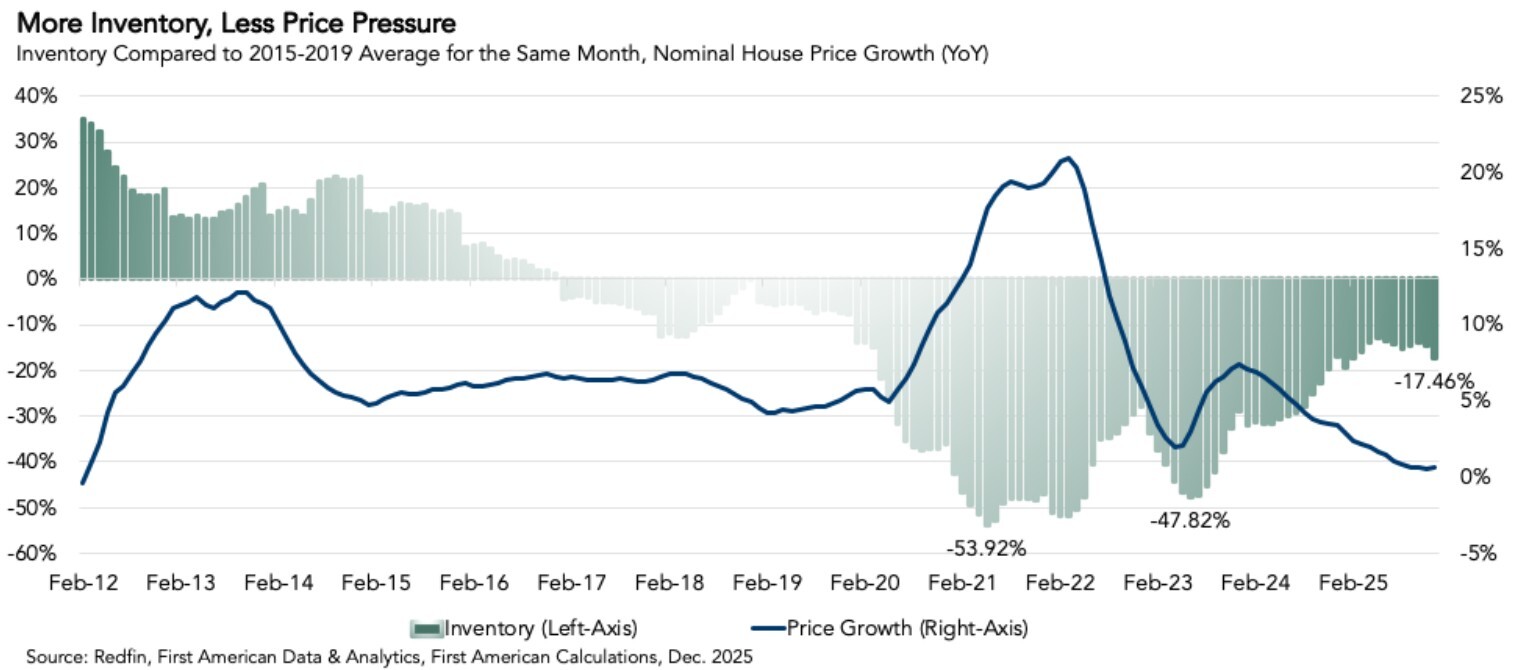
Keep an Eye on Inventory
Nonetheless, life events—job changes, household formation, and relocation—will continue to draw both buyers and sellers off the sidelines in 2026. That gradual life-event re-engagement should support more inventory and more sales transactions. As long as inventory levels don’t deteriorate dramatically because more buyers than sellers enter the market, house price growth will remain in check, allowing affordability to continue to steadily improve. As the market improves in 2026, keep a watchful eye on inventory.
Sources:
• First American Data & Analytics
• Freddie Mac
• Census Bureau
November 2025 Real House Price Index Highlights
The First American Data & Analytics’ Real House Price Index (RHPI) showed that in November 2025:
- Real house prices decreased 0.4 percent between October 2025 and November 2025.
- Real house prices decreased 8.5 percent between November 2024 and December 2025.
- Consumer house-buying power, how much one can buy based on changes in income and mortgage rates, increased 0.6 percent between October 2025 and November 2025, and increased 9.8 percent year over year.
- Median household income has increased 3.5 percent since November 2024 and 58.6 percent since January 2015.
- Real house prices are 25.3 percent more expensive than in January 2000.
- Unadjusted house prices are now 63.3 percent above the housing boom peak in 2006, while real, house-buying power-adjusted house prices are 12.2 percent below their 2006 housing boom peak.
November 2025 Real House Price State Highlights
- The only state with a year-over-year increase in the RHPI is Maine (+0.6 percent).
- The five states with the greatest year-over-year decrease in the RHPI are: Florida (-15.8 percent), New York (-11.7 percent), Georgia (-11.7 percent), Nevada (-11.5 percent), and Washington (-11.4 percent).
November 2025 Real House Price Local Market Highlights
- Among the Core Based Statistical Areas (CBSAs) tracked by First American Data & Analytics, the markets with the greatest year-over-year increase in the RHPI are: Cincinnati (+2.3 percent), Cleveland (+1.5 percent), and Hartford (+1.3 percent).
- Among the Core Based Statistical Areas (CBSAs) tracked by First American Data & Analytics, the five markets with the greatest year-over-year decrease in the RHPI are: Miami (-20.9 percent), Tampa, Fla. (-16.5 percent), Atlanta (-15.9 percent), Seattle (-15.5 percent), and San Francisco (-14.6 percent).
Next Release
The next release of the First American Data & Analytics’ Real House Price Index will take place the week of February 16, 2026.
About the First American Data & Analytics’ Real House Price Index
The traditional perspective on house prices is fixated on the actual prices and the changes in those prices, which overlooks what matters to potential buyers - their purchasing power, or how much they can afford to buy. First American Data & Analytics’ proprietary Real House Price Index (RHPI) adjusts prices for purchasing power by considering how income levels and interest rates influence the amount one can borrow.
The RHPI uses a weighted repeat-sales house price index that measures the price movements of single-family residential properties by time and across geographies, adjusted for the influence of income and interest rate changes on consumer house-buying power. The index is set to equal 100 in January 2000. Changing incomes and interest rates either increase or decrease consumer house-buying power. When incomes rise and mortgage rates fall, consumer house-buying power increases, acting as a deflator of increases in the house price level. For example, if the house price index increases by three percent, but the combination of rising incomes and falling mortgage rates increase consumer buying power over the same period by two percent, then the Real House Price index only increases by 1 percent. The Real House Price Index reflects changes in house prices, but also accounts for changes in consumer house-buying power.
Disclaimer
Opinions, estimates, forecasts and other views contained in this page are those of First American’s Chief Economist, do not necessarily represent the views of First American or its management, should not be construed as indicating First American’s business prospects or expected results, and are subject to change without notice. Although the First American Economics team attempts to provide reliable, useful information, it does not guarantee that the information is accurate, current or suitable for any particular purpose. © 2025 by First American. Information from this page may be used with proper attribution.