
Key Points:

- Affordability posted its seventh straight year-over-year improvement in September 2025.
- Consensus forecasts indicate that mortgage rates will remain sticky, hovering in the low-6 percent range and ease only gradually into 2026.
- Affordability is expected to improve by 3 percent on a year over year basis by the end of 2026, as income growth outpaces house price growth.
Housing affordability improved year over year for the seventh consecutive month in September 2025, marking the longest stretch of annual gains since the late-2019 to early-2020 period. While affordability remains 66 percent lower than the pre-pandemic five-year average, the recent trend points to a slow, but meaningful shift in the market’s trajectory. The forces that eroded affordability in the aftermath of the pandemic—strong price appreciation and surging mortgage rates—have stabilized. Moderating house price growth, easing mortgage rates, and steady income gains signal a realignment in the forces driving affordability trends.
“Affordability won’t snap back overnight, but like a ship finally catching a steady tailwind, it’s now sailing in the right direction.”
2026 Affordability Outlook: The Forces That Matter Most
Our Real House Price Index (RHPI), which adjusts nominal house prices for income and interest-rate changes, shows that house-buying power has subtly improved this in 2025. With mortgage rates edging off their highs and household incomes continuing to rise alongside moderate price growth, the “real” measure of affordability is poised to continue modestly improving through 2026. The improvement will not be dramatic, but it is durable—and that matters. These three dynamics together determine how far a home buyer’s dollar can stretch.
Mortgage Rates Will Ease, but Remain Elevated
While the broader economic data has been uneven in recent months, one theme has persisted: inflation has cooled, but remains above the Federal Reserve’s target, prompting policymakers to ease cautiously, rather than aggressively. The Fed’s caution matters because affordability is highly sensitive to movements in long-term interest rates, not just the federal funds rate. For example, despite the Fed’s shift toward easing, the 10-year Treasury yield remains elevated compared with pre-pandemic norms. Lingering inflation concerns, persistent fiscal deficits, and heavy Treasury issuance continue to push the term premium higher. As a result, mortgage rates have a near-term floor. By year-end 2026, consensus estimates place the average 30-year mortgage rate near 6.2 percent. This limits the amount of affordability relief that lower rates alone can deliver. Any improvements in rates in 2026 will be incremental, not sweeping.
House Price Growth Will Slow, but Not Reverse
Nominal house price appreciation has already cooled significantly, and consensus forecasts point to approximately one percent annual growth by the end of 2026. But, despite slowing demand from higher mortgage rates, house prices nationally are not expected to turn negative. Structural supply shortages—over a decade of underbuilding and a lock-in effect keeping existing owners in place—continue to put a floor under prices. The housing supply floor is why slow appreciation is the more likely outcome, rather than outright declines nationally, even in a higher-rate environment.
Income Growth Will Outpace House Price Growth
An important dynamic for affordability is that household income is expected to rise faster than house prices next year. According to the New York Fed’s Survey of Consumer Expectations, median expected household income growth is 2.8 percent. When income growth exceeds house price growth, house-buying power improves—even if mortgage rates don’t decline meaningfully. This is a key driver of the roughly 3 percent improvement in affordability we expect between the end of this year and end of 2026, which would return affordability to levels not seen since the summer of 2022.
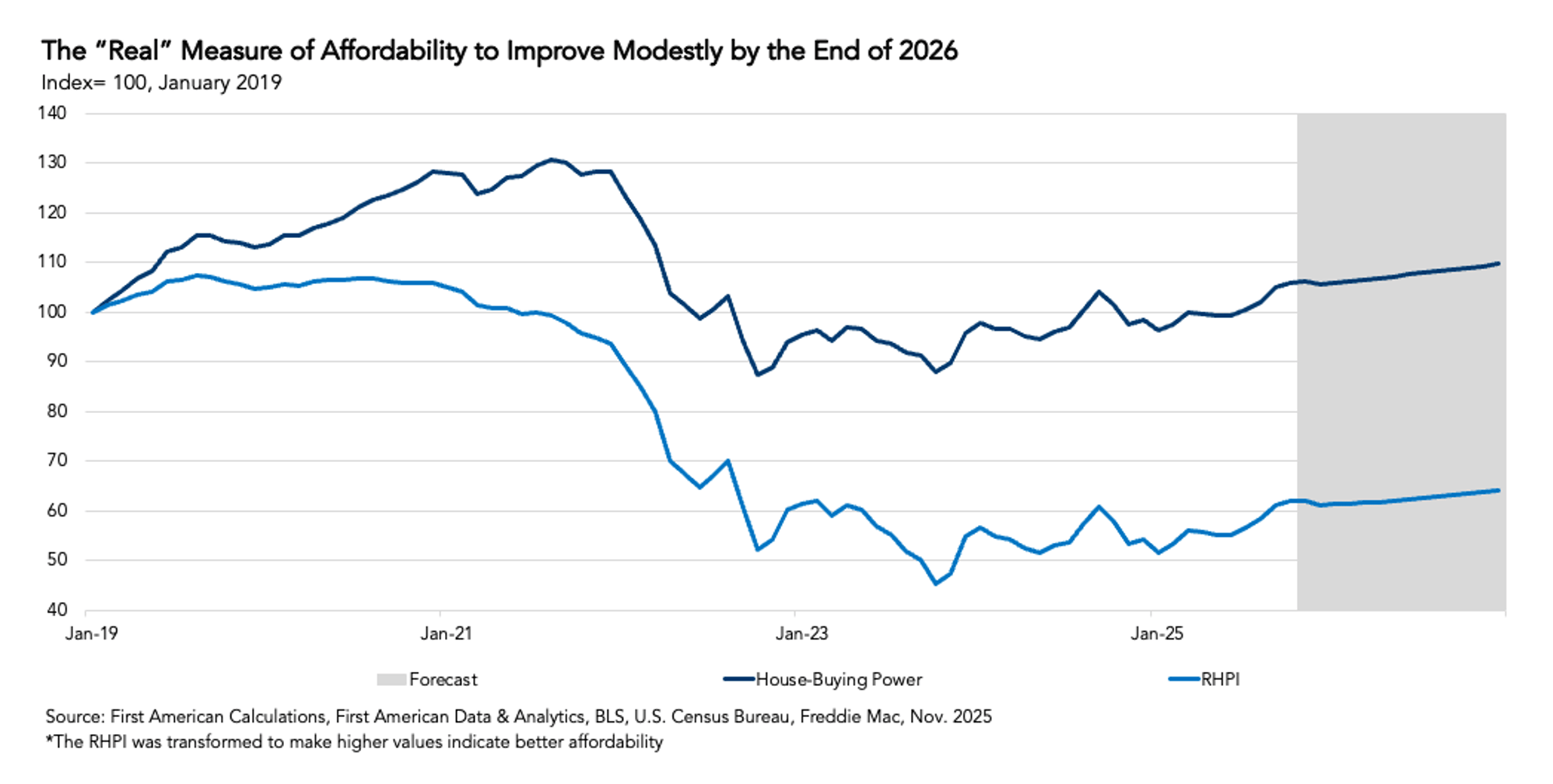
A Gradual Path to Better Affordability
Affordability remains challenging, but for the first time in several years, the underlying forces are finally aligned toward gradual improvement. Mortgage rates may drift down only slowly, but income growth exceeding house price appreciation will provide a boost to house-buying power — even in a higher-rate world. Affordability won’t snap back overnight, but like a ship finally catching a steady tailwind, it’s now sailing in the right direction.
Sources:
September 2025 Real House Price Index Highlights
The First American Data & Analytics’ Real House Price Index (RHPI) showed that in September 2025:
- Real house prices decreased 0.1 percent between September 2024 and September 2025.
- Real house prices decreased 2.5 percent between August 2025 and September 2025.
- Consumer house-buying power, how much one can buy based on changes in income and mortgage rates, increased 2.7 percent between August 2025 and September 2025, and increased 0.8 percent year over year.
- Median household income has increased 2.6 percent since September 2024 and 57.1 percent since January 2015.
- Real house prices are 27.7 percent more expensive than in January 2000.
- Unadjusted house prices are now 63.0 percent above the housing boom peak in 2006, while real, house-buying power-adjusted house prices are 10.5 percent below their 2006 housing boom peak.
September 2025 Real House Price State Highlights
- The five states with the greatest year-over-year increase in the RHPI are: Maine (+8.3 percent), New Hampshire (+8.0 percent), Wyoming (+6.3 percent), North Dakota (+6.2 percent), and Connecticut (+5.5 percent).
- The five states with the greatest year-over-year decrease in the RHPI are: Florida (-9.2 percent), Nevada (-6.2 percent), Texas (-3.5 percent), Colorado (-3.4 percent), and Virginia (-3.3 percent).
September 2025 Real House Price Local Market Highlights
- Among the Core Based Statistical Areas (CBSAs) tracked by First American Data & Analytics, the five markets with the greatest year-over-year increase in the RHPI are: Cincinnati (+10.3 percent), Buffalo, N.Y. (+8.4 percent), Hartford, Conn. (+7.6 percent), Cleveland (+7.4 percent), and Milwaukee (+7.0 percent).
- Among the Core Based Statistical Areas (CBSAs) tracked by First American Data & Analytics, the five markets with the greatest year-over-year decrease in the RHPI are: Miami (-13.8 percent), Tampa, Fla. (-12.9 percent), Riverside, Calif. (-9.6 percent), Seattle (-8.5 percent), and Atlanta (-7.6 percent).
Next Release
The next release of the First American Data & Analytics’ Real House Price Index will take place the week of December 29, 2025.
About the First American Data & Analytics’ Real House Price Index
The traditional perspective on house prices is fixated on the actual prices and the changes in those prices, which overlooks what matters to potential buyers - their purchasing power, or how much they can afford to buy. First American Data & Analytics’ proprietary Real House Price Index (RHPI) adjusts prices for purchasing power by considering how income levels and interest rates influence the amount one can borrow.
The RHPI uses a weighted repeat-sales house price index that measures the price movements of single-family residential properties by time and across geographies, adjusted for the influence of income and interest rate changes on consumer house-buying power. The index is set to equal 100 in January 2000. Changing incomes and interest rates either increase or decrease consumer house-buying power. When incomes rise and mortgage rates fall, consumer house-buying power increases, acting as a deflator of increases in the house price level. For example, if the house price index increases by three percent, but the combination of rising incomes and falling mortgage rates increase consumer buying power over the same period by two percent, then the Real House Price index only increases by 1 percent. The Real House Price Index reflects changes in house prices, but also accounts for changes in consumer house-buying power.
Disclaimer
Opinions, estimates, forecasts and other views contained in this page are those of First American’s Chief Economist, do not necessarily represent the views of First American or its management, should not be construed as indicating First American’s business prospects or expected results, and are subject to change without notice. Although the First American Economics team attempts to provide reliable, useful information, it does not guarantee that the information is accurate, current or suitable for any particular purpose. © 2025 by First American. Information from this page may be used with proper attribution.