
Key Points:
- Office conversions have reduced total office stock by less than 1 percent, too little to offset the post-pandemic collapse in demand.
- New office construction has continued to outpace conversions, even amid historically weak demand.
- With office starts at multi-decade lows, conversion activity is becoming large enough relative to the pipeline to influence net supply, but likely not until later next year.
Five years after the onset of the COVID-19 pandemic, the office market remains the commercial real estate (CRE) asset class hit hardest by the pandemic and its aftereffects. The widespread adoption of remote work has permanently reduced office demand, leaving the market with more space than today’s level of demand can absorb.
Consequently, office conversions have become a major topic of discussion among CRE professionals. The challenges involved are well known, which helps explain why conversions have not yet occurred at a scale large enough to meaningfully change office supply conditions nationally. However, that could change in a just few years. With new office construction starts down sharply, conversions may eventually strip more space from the market than new development adds.
So, why haven’t conversions moved national supply-and-demand dynamics yet? The short answer is scale. The clearest way to see that is by comparing conversions to two benchmarks: the size of the existing office market (the stock) and the amount of new office space being added (the flow).
“The next phase of office development isn’t new construction. It’s subtraction.”
Taking Stock
Let’s start with conversions relative to existing office inventory. At the beginning of 2020, there was an estimated 7.9 billion square feet of office inventory nationally. Over the past five years, only about 52 million square feet of office space has been converted to other uses across major markets, which represents only a 0.7 percent reduction in office inventory over that time period.
That’s a sizable amount of office space in absolute terms, roughly equivalent to the inventory of office space in Downtown Houston as of the third quarter of 2025. However, it is small relative to the national office market. Over the same period, national office vacancy spiked sharply — from 9.4 percent in the fourth quarter of 2019 to 14 percent in the fourth quarter of 2025, with measures of physical utilization suggesting even more slack than conventional vacancy rates imply. For context, that 14 percent vacancy rate amounts to nearly 1.2 billion vacant square feet of space today compared to the 52 million square feet in conversions completed over the last five years.
Conversions Versus New Supply
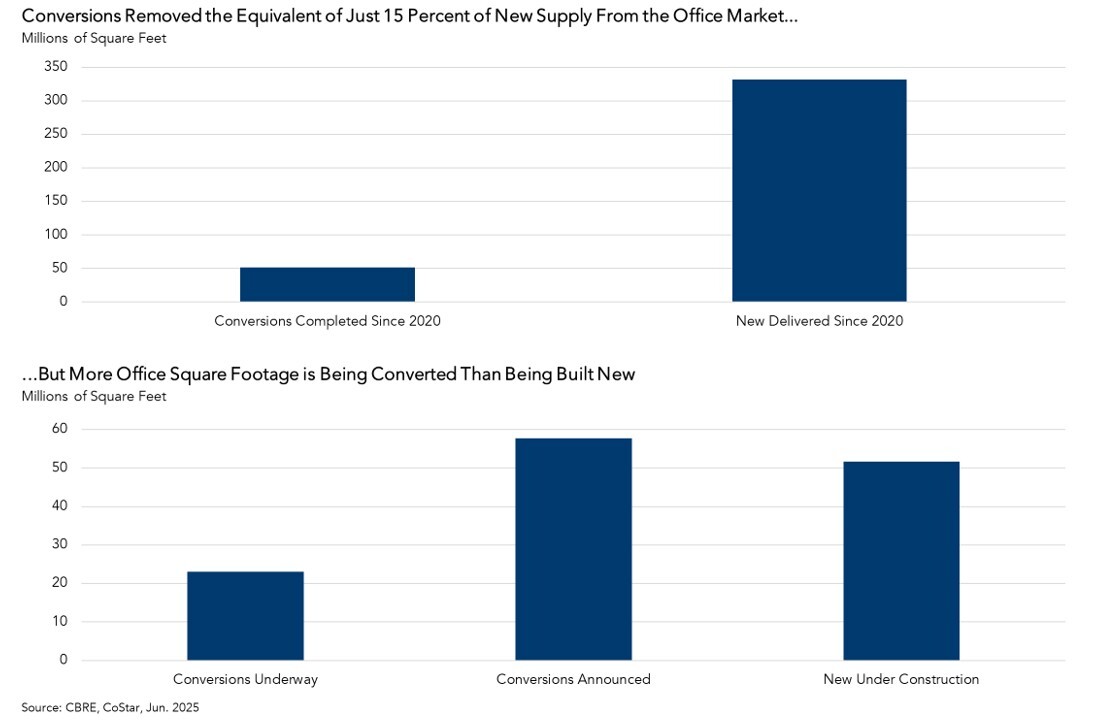
Another way to frame the issue is to compare conversions with new supply. From the first quarter of 2020 through the second quarter of 2025, roughly 332 million square feet of new office space was delivered nationally. Converted space over that same period offset only about 15 percent of those additions. Put differently, the office market still added roughly 301 million square feet of net-new space over the period (excluding demolitions), making it difficult for conversions to meaningfully influence national supply conditions, regardless of how weak demand has been.
If Not Now, When?
These stock and delivery comparisons explain why conversions haven’t mattered much so far, but the picture changes when you look ahead to the construction pipeline. Inventory adjusts slowly, while development activity can shift more quickly. When new office construction falls to very low levels, the number of conversions doesn’t need to be large relative to total stock to matter at the margin.
Conversion activity already exceeds what’s currently being built, if planned conversions are included. As of the second quarter of 2025, CBRE estimates that about 23 million square feet of office conversions are underway, with another 58 million square feet announced, but not yet started, for a total of approximately 81 million square feet. By comparison, 52 million square feet of office space is currently under construction. If all conversion projects underway and announced were completed and no new ones began, conversions would outpace current new construction by 56 percent.
Supply Subtraction
Adaptive reuse of office space has increased as office demand has fallen, but its impact depends on how the comparison is framed. Completed conversions remain small relative to the total office market, which explains why they haven’t yet moved national conditions in a meaningful way.
At the same time, conversions are growing relative to the office construction pipeline. If office starts remain depressed, conversions don’t need to be large relative to existing stock to help slow vacancy growth and bring supply and demand back toward balance over the intermediate term. The next phase of office development isn’t new construction. It’s subtraction.