

Key Points:
- Cap rates are unlikely to fall materially in the new cycle. Income, not valuation, will drive a greater share of CRE returns.
- Debt supply, not interest rates, is the stronger historical driver of cap-rate movement.
- Most CRE professionals lack lived experience operating in periods of flat or rising cap rates, which may make this adjustment challenging.
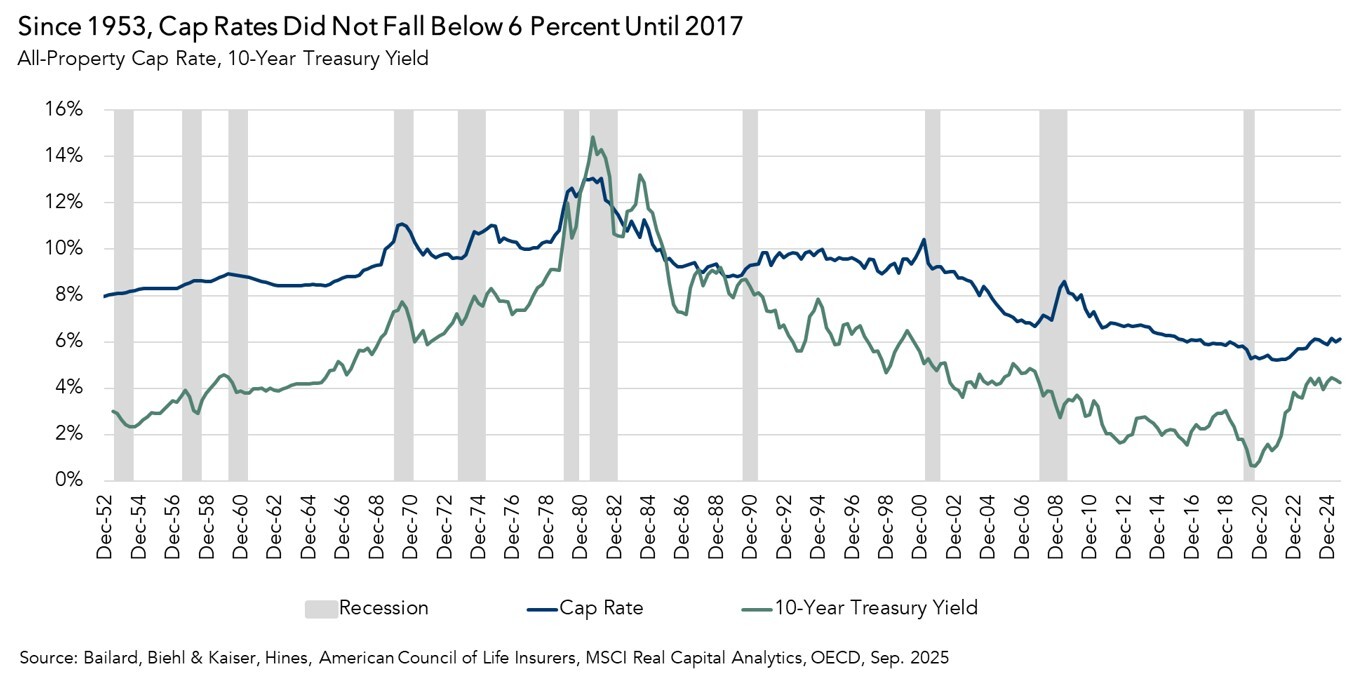
In our 2026 commercial real estate (CRE) outlook, we noted that 2026 will be a year where the new CRE cycle takes off. However, this new cycle won’t resemble the last two that many CRE professionals know best. Since 2000, cap rates have mostly drifted downward, interrupted only briefly by the Global Financial Crisis (GFC). That long decline created the impression that steady cap rate compression is a normal feature of CRE expansions. But, when we extend the data back to 1953, a different pattern emerges. Long stretches of sideways, choppy, or even rising cap rates are far more common than sustained declines. That longer history offers a more realistic guide for the cycle ahead.
This piece complements our recently published 2026 forecast, but takes a broader look at how the next CRE cycle may unfold.
“The new cycle is here, but it will take shape against a backdrop that’s more reminiscent of 1991-1999—an environment marked by uneven, generally sideways cap rate movement—rather 2000-2025, where there were sustained declines.”
Limited Valuation Tailwinds
Even as the CRE recovery strengthens, this cycle won’t deliver the same valuation lift seen in the last two. Over the past 25 years, cap rates fell from roughly 10 percent in 2000 to 6 percent today, creating a built-in tailwind for two generations of CRE professionals. However, that pattern is historically unusual. From 1968 to 2000, cap rates hovered at or above 10 percent, only briefly dipping below 9 percent in the late 1980s. Going back to 1952, cap rates never fell below 8 percent until 2005 and didn’t dip under 6 percent until 2017. Against that backdrop, the 5.2 percent low in 2021 looks more like an outlier than a level the market should expect to revisit anytime soon.
The 1991–99 recovery that followed the Savings and Loan (S&L) crisis arguably offers the closest historical analogue to today. Both periods followed inflation-driven interest rate shocks that eroded the value of fixed income assets and commercial properties, exposing lax underwriting discipline and putting many financial institutions under pressure. After the S&L-related recession ended in 1991, cap rates moved sideways for most of the next decade. With little help from cap rate declines, income growth had to shoulder a greater role in generating CRE returns during this period. If rent growth remains modest, operating discipline will matter more than cap rate compression. In the coming cycle, income will play a larger role in returns than price appreciation.
Interest Rates Only Part of the Cap Rate Story
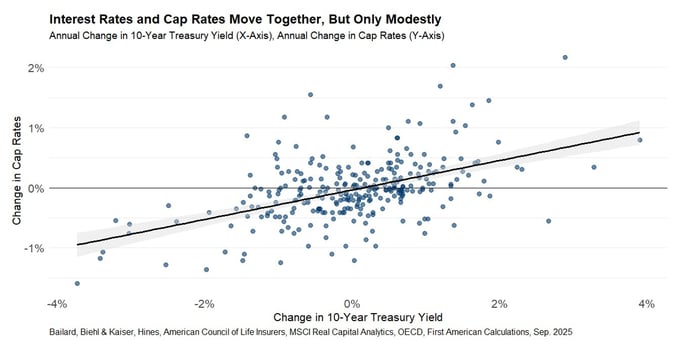
Much attention is paid to the relationship between cap rates and interest rates, and for good reason —the spread between the two reflects the risk premium investors demand over a safer Treasury bond. But, while interest rates help to explain cap rate movements, they do so only to a limited extent. Looking back roughly 70 years, changes in interest rates alone explain just under 25 percent of the variation in cap rates – a statistically significant, but weak relationship. Some periods show the relationship breaking down entirely, with interest rates moving one way while cap rates move the other. This underscores that most cap rate movement is driven by forces beyond interest rates alone, such as the amount of CRE credit available in the economy.
For Cap Rates, Debt Supply Matters More than Debt Prices
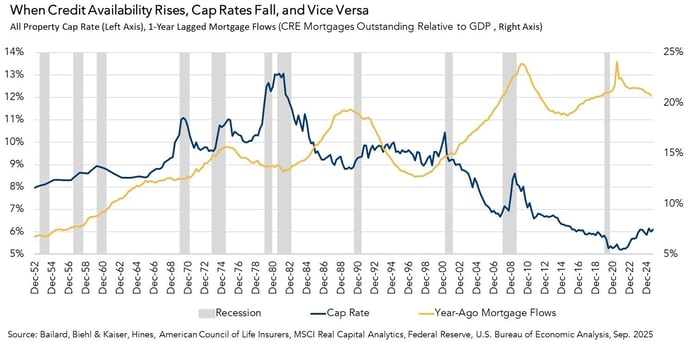
A substantial body of research shows that the quantity of CRE mortgage debt in the economy is often a better predictor of cap rate movements than the price of that debt. In simpler terms, cap rates respond more to how much credit is available than to the level of interest rates themselves.
CRE is a credit intensive asset class. Buyers rely heavily on financing to acquire properties, so when lenders actively supply credit, transaction activity rises and cap rates typically fall. When credit availability tightens, transactions slow and cap rates generally rise, regardless of where interest rates are. As shown in the chart below, this relationship has held for most of the last 70 years, with two notable exceptions. In the 1950s, CRE debt availability expanded steadily even as cap rates climbed, and in the period after the GFC, CRE mortgage flows contracted sharply while cap rates also fell. It’s a reminder that the most recent cycle was the anomaly, not the historical norm.
Limited Professional Experience with Persistent Valuation Headwinds
Because cap rates have trended almost exclusively down for most of the last 25 years—save for the brief post-GFC liquidity crunch—only a limited number of today’s CRE professionals have worked through a market where cap rates moved sideways or up for an extended period. In a recent First American webinar, 61 percent of respondents reported entering the CRE industry between the 2000s and today, meaning most have never experienced a multi-year period like the post-S&L 1990s. Only 1 percent began their careers in the 1970s, when the industry experienced its sharpest cap rate surge over the past 75 years.
This gap in lived experience shapes expectations. Many practitioners have spent their entire careers in an environment where cap rate declines boosted returns and masked potential operational shortcomings. The next cycle is unlikely to offer that same support.

New Cycle, New Hope, Same Old Challenges
The new cycle is here, but it will take shape against a backdrop that’s more reminiscent of 1991-1999—an environment marked by uneven, generally sideways cap rate movement—rather than 2000-2025 where there were sustained declines. Some asset classes may still see cap rate declines next year, particularly those where fundamentals are improving, but cap rates are unlikely to fall substantially throughout this cycle. Instead, income growth and operational execution will drive a larger share of total returns in this cycle. Valuation gains will play a smaller, more variable role. For many in the industry, that shift will require an adjustment, but it aligns more closely with the long arc of CRE history than the unusual run of the last 25 years.