

Key Points:
- Countywide rent growth increased modestly after the fires, but the effects were far more pronounced at the neighborhood level.
- In both the Palisades and Eaton Canyon areas, rents eventually stabilized in the burn zones themselves, while accelerating in surrounding zip codes as displaced households reassessed longer-term housing plans.
- Even after the fires were extinguished, prolonged cleanup timelines and lost amenities continued to shape rental demand across nearby communities throughout 2025
It’s been a year since a deadly combination of prolonged dryness and Santa Ana winds ignited some of the most destructive fires in Los Angeles history. I’m a Los Angeles native and grew up accustomed wildfire season, but I had never experienced anything quite like the night of January 7 and the morning of January 8, 2025.
On the 7th, we spent much of the day trying to confirm that close family friends had made it out of the Palisades. They did, but, like so many others, they unfortunately lost their home. As the day went on, people were abandoning cars along the limited routes out of the neighborhood. Later that night, the Eaton fire started. When my wife and I fell asleep around midnight, about 200 acres were burning in Altadena, a little over five miles east of us. Wind gusted to 100 miles per hour overnight. By 6 a.m., the fire had grown more than tenfold, to over 2,200 acres, and it would expand far beyond that before it was contained. When I looked out the window that morning, a dense black plume rose into the sky.
These weren’t the only fires that occurred during the event last January, but the Palisades and Eaton Canyon fires were the most damaging. Together, they destroyed approximately 18,000 structures and displaced more than 200,000 people across the Los Angeles metro area. For households who lost homes, or whose homes became unlivable, finding a place to live meant entering an already undersupplied housing market.
Wildfires can reshape housing demand well beyond the immediate disaster. Using Zillow rent data on single-family and multifamily rentals in conjunction with Cal Fire structure damage data, this post tracks rent changes after the fires. The headline is straightforward: countywide rent growth picked up briefly, while the largest increases showed up in communities closest to the burn areas. A year later, rents in the most damaged ZIP codes have mostly returned to pre-fire levels, but several surrounding areas remain higher.
“It’s a reminder that the housing impacts of major wildfires can linger long after the flames are out.”
Countywide
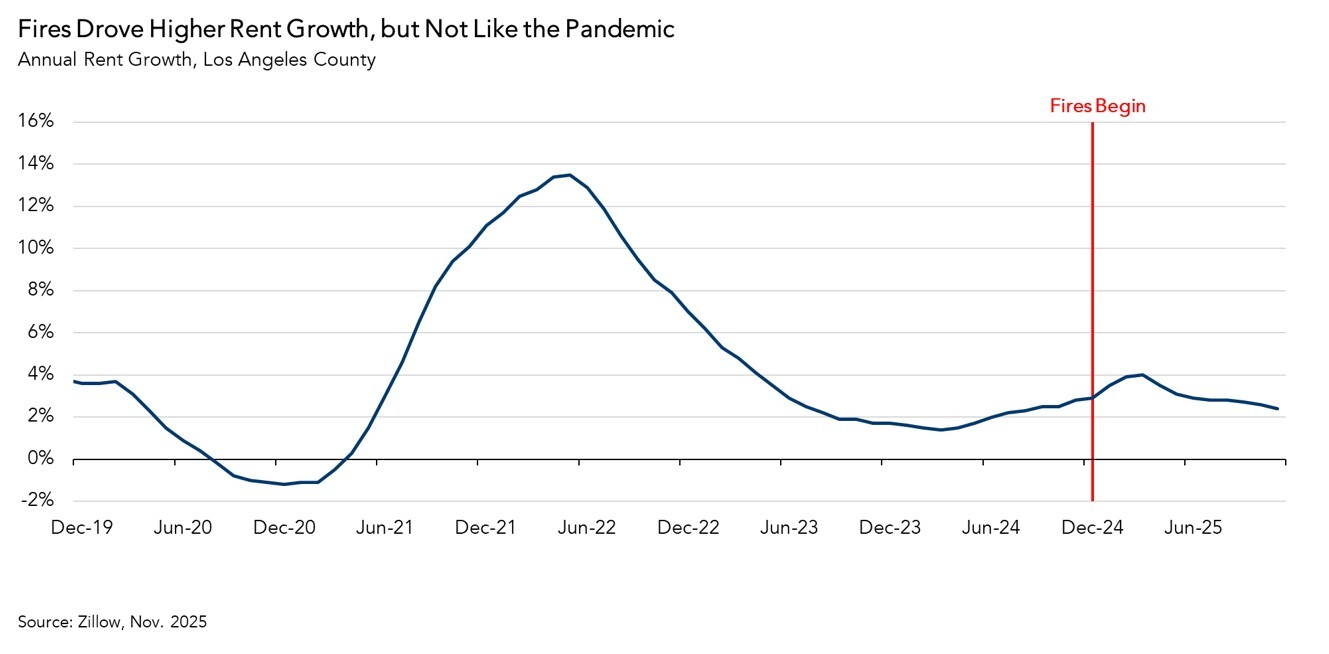
Countywide, the fires were followed by modestly higher rent growth. In December 2024, annual rent growth in Los Angeles County was 2.9 percent. By March 2025, two months after the fires were extinguished, rent growth had risen to 4.0 percent. After March, rent growth eased. As of November, it had returned to roughly pre-fire levels (2.4 percent). Overall, rents in Los Angeles County in November 2025 are about 2.1 percent higher than in December 2024. In short, the countywide impact was measurable, but temporary.
Pacific Palisades and Nearby Areas
Most of the damage from the Palisades fire occurred in the 90272 ZIP code, where more than half of all structures were damaged. Some properties were also affected in neighboring Malibu (90265) and Topanga Canyon (90290). In the immediate aftermath of the fire, rents in the Palisades (90272) jumped – up 10.3 percent in April 2025 compared to December 2024. But, by November 2025, rent growth in the 90272 ZIP code was essentially flat compared to December 2024. In contrast, several nearby ZIP codes posted sustained increases through November, suggesting demand shifted outward as rebuilding and livability constraints persisted.
- Van Nuys (91436) – 20.8 percent.
- Santa Monica (90402) – 14.5 percent
- Beverly Hills (90210) – 14.5 percent
- Manhattan Beach (90266) – 9.3 percent
- Tarzana (91356) – 8.0 percent
- Brentwood (90049) – 7.8 percent
- Malibu (90265) – 7.1 percent

Eaton Canyon
On the east side of Los Angeles, the Eaton Canyon fire primarily damaged structures in the 91001 zip code (Altadena), though parts of Pasadena were also affected. Three months after the fire, in April 2025, rents in Altadena were 5.7 percent higher than in December 2024, while neighboring ZIP codes posted increases of roughly 2 to 4 percent. By November 2025, rents in Altadena were about 6 percent above December 2024 levels. As with the Palisades, rent growth was often stronger in nearby communities than in Altadena itself.
- Temple City (91780) – 10.7 percent
- Burbank (91352)– 10.1 percent
- Whittier (90601) – 8.9 percent
- Alhambra (91775 and 91776) – 8.0 percent
- Monrovia (91016) – 7.8 percent
- Eagle Rock (90041) – 6.9 percent
- Arcadia (91007) – 6.5 percent

This data can’t tell us that fires were the only reason rents increased in the nearby areas, but the geographic pattern is consistent. In 2025, the largest rent increases were clustered near the neighborhoods most affected by the fires. One year later, the rent shock looks less like a countywide surge and more like a localized shift—temporary normalization in the burn zones, paired with more persistent pressure in surrounding communities. It’s a reminder that the housing impacts of major wildfires can linger long after the flames are out.
Sam Williamson contributed to the spatial mapping for this report.