

Key Points:
- The CRE market is healthier than it was a year ago, with improving transaction volume, more stable pricing, and renewed capital market activity.
- The rate-driven repricing phase is mostly over, shifting the near-term outlook toward underlying tenant demand and consumer resilience.
- Lingering distress remains a challenge, but it may also create opportunities for investors before market clarity fully returns.
By most accounts, the commercial real estate (CRE) market is on relatively firm footing, with the market in a much better place than it was a year ago. Sale and refinance transaction volume is increasing. Pricing is less of a guessing game than it was in 2023 and 2024, which has drawn lenders back into the market and spurred greater origination activity. Equity capital, too, is beginning to move, albeit not all at once.
The “wait and see” posture that defined much of the last several years as the market went through an adjustment is transitioning to a more active search for opportunities, as buyers and sellers can now broadly agree on property values. The narrowing of this bid-ask spread is the turning point where the CRE business cycle moves from contraction to expansion, paving the way for accelerated momentum as more transactions are completed and market liquidity improves.
“The tension between healthier capital markets and a somewhat uncertain demand outlook will define the back half of this year.”
The Great Repricing is (Mostly) Over
Ever since the world had to come to terms with the non-transitory nature of inflation in late 2021 and early 2022, interest-rate movements and capital markets activity have dominated conversations about CRE. The speed at which rates increased triggered a sharp correction in the CRE market. Debt was suddenly far more expensive, so less of it could be used to fund acquisitions, which sapped purchase demand and drove prices down. Cap rates rose to adjust to this new, higher-cost-of-capital environment and, as bid-ask spreads widened, transaction volume dried up.
The adjustment phase appears to be largely complete. Not everywhere – office buildings continue to face unique challenges – but, broadly speaking, the rate-driven price discovery process has run its course across much of the market.
Demand Takes the Wheel
With pricing more stable and capital markets functioning more normally, the near-term outlook for CRE will increasingly depend on underlying demand for space, rather than further adjustments in interest rates. As a result, the biggest near- to intermediate-term risk to CRE isn’t the Fed’s next policy decision, but whether tenant demand can remain resilient if consumers and businesses become more cautious or financially stretched. The exception would be inflation becoming more entrenched across the broader economy, which could precipitate another rate-hike cycle and push interest rates higheracross the yield curve.
The strength of the consumer, in particular, is worth watching. Though real wages had been growing since mid-2023 due to disinflation, that trend has recently reversed. Real wage growth has now declined for two consecutive months due to a reacceleration in inflation. In other words, the real wage growth cushion is thinning, diminishing one of the tailwinds supporting broader consumer spending. Though this reacceleration in inflation is not entirely attributable to energy prices, they have been a primary driver, and higher energy prices reduce spending power in other discretionary categories.
Recent trends in consumer debt also warrant attention. Credit card and auto delinquencies continue to rise. Delinquency rates for student loan payments, which rejoined household budgets about a year ago, also remain elevated. This doesn’t necessarily point to a collapse in consumer spending, but it does suggest that consumers have less room for error if something goes wrong.
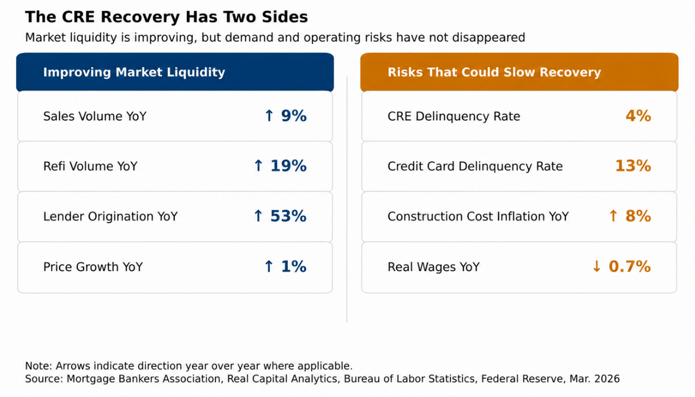
Falling demand can impact CRE in several ways. Weaker retail spending can eventually translate into declining demand for retail space. Similarly, if goods consumption declines, demand for warehouse space could soften. Slower hiring can translate into less demand for office space. And, if housing affordability remains strained while household budgets tighten, some renters may need to find roommates, which could slow renter household formation.
Digesting Distress Well into Next Year
Outstanding CRE debt distress represents a sort of double-edged sword. It remains elevated, especially in office and in certain floating-rate or bridge multifamily loans. If you’re the owner of a distressed apartment property with a bridge loan maturing soon, today doesn’t feel like much of a recovery. But, from a broader market perspective, distress also creates the discounts and forced-sale situations that attract capital to the market. Once most of that distress is resolved, there will be fewer discounted buying opportunities available. Investors waiting for perfect clarity may find that many of the best opportunities have already passed by then.
The recovery is real, and the market is healthier than it was a year ago. But better doesn’t mean easy, and temporary doesn’t mean brief. The second half of the year will hinge on two critical questions: whether improving capital market conditions can outrun a more uncertain demand environment, and whether inflation will re-entrench significantly to push financial conditions back into tightening territory. The tension between healthier capital markets and somewhat uncertain demand will define the back half of this year.