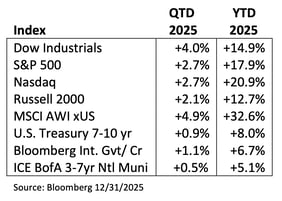
 2025 was a very good year for global financial markets, featuring strong performance across major asset classes, including domestic and international equities, bonds, and precious metals. Despite bouts of significant geopolitical turmoil, including sharp changes in U.S. trade and tariff policies, escalation in the U.S.-China rivalry, and armed conflict in Ukraine and the Middle East, the “everything rally” was supported by resilient global economic growth, cooling inflation across the globe, and a synchronized global central bank rate cutting cycle, excluding the Bank of Japan.
Domestic equity markets finished 2025 with significant gains, impressively marking the third consecutive year of strong double-digit appreciation. Market performance was driven by both multiple expansion and steady improvement in corporate fundamentals, supported by easing inflation and a more accommodative monetary policy backdrop.
U.S. market leadership began to broaden in the fourth quarter, though full-year S&P 500 returns were still overwhelmingly driven by the Technology and Communications Services sectors, with large-cap growth companies benefiting from AI and the semiconductors that power it. A wider range of sectors and styles participated in the fourth quarter as economic conditions stabilized, and investors gained confidence in the durability of the expansion.
Domestic fixed income markets also delivered strong returns in 2025 supported by declining yields and stable credit conditions, although performance in the fourth quarter was modest, reflecting a period of consolidation following earlier gains. Starting yields remained attractive by historical standards, while declining rate volatility supported total returns. As cash yields moved lower alongside Federal Reserve interest rate cuts, core bonds regained their appeal as a durable source of income and diversification.
The U.S. economy remained resilient throughout 2025, with real GDP growth accelerating at year-end. Consumer spending slowed modestly but remained supported by healthy household balance sheets and rising real incomes as inflation eased. Business investment held up well, particularly in areas tied to automation, infrastructure, the energy transition, and data center expansion. Labor market conditions gradually normalized as job growth moderated from the elevated pace of prior years, and the unemployment rate rose, though it remained consistent with a stable expansion. Importantly, wage growth decelerated without a sharp deterioration in employment, helping ease inflationary pressures while sustaining consumer purchasing power.
Inflation made further progress toward the U.S. Federal Reserve’s 2% target. Both CPI and PCE inflation trended lower over the course of the year, allowing the Fed to shift policy from restrictive toward a more neutral stance. Beginning in September, the Fed delivered 75 bps of rate cuts in 2025, reinforcing confidence that inflation risks were increasingly balanced and reducing the likelihood of policy-driven economic stress.
Sector performance in 2025 reflected a more normalized market environment. Communication Services and Technology continued to benefit from secular growth trends, but leadership expanded to include Industrials, Financials, and select areas of Health Care. Financials were supported by improving capital markets activity, stable credit conditions, and easing funding pressures. Industrials benefited from sustained capital spending and government-supported infrastructure initiatives, while Utilities delivered steady returns amid ongoing investment in power generation and grid modernization.
In a marked change from recent years, international equities outperformed U.S. markets by a large margin. Although economic growth abroad remained uneven, particularly in Europe and China, performance improved in the second half of the year with both benefitting from easing inflation, lower policy rates and modest fiscal stimulus. Japanese equities also performed well despite several interest rate hikes. Emerging Markets were the best performing international equity asset class, outpacing the S&P 500 for the first time since 2017, supported by the weaker dollar, rising commodity prices and prudent fiscal and monetary policy.
Looking ahead to 2026, the outlook for both the economy and financial markets continues to be constructive. With inflation largely contained and monetary policy closer to neutral, the foundation is in place for continued economic expansion rather than late-cycle deterioration. We expect U.S. GDP growth to remain near trend, supported by improving real income growth, easing financial conditions, and ongoing productivity gains driven by technology adoption and capital investment.
Corporate earnings are expected to remain solid in 2026, with consensus pointing to 14.5% growth, driven by a broader set of sectors as margin pressures stabilize and revenue growth remains healthy. Importantly, productivity improvements from AI, automation, and infrastructure investment should help offset higher labor and input costs, supporting profitability across a wider range of industries.
Equity valuations remain above long-term averages, but they appear somewhat more sustainable in an environment of moderating inflation, declining interest rates, and steady earnings growth. As a result, we expect equity returns in 2026 to be positive and more evenly distributed across sectors and styles, rather than dominated by a narrow group of companies. This backdrop should favor active positioning and disciplined security selection.
From a portfolio perspective, although we maintain a modest preference for U.S. equities relative to foreign markets, we believe markets are close to the point where it would be prudent to increase the allocation to international markets. Within equities, we continue to emphasize high-quality companies with strong competitive positions, consistent cash flow generation, and exposure to long-term investment themes.
In fixed income, our focus remains on resilience, income generation, and capital preservation. We favor high-quality, liquid sectors that can perform across a range of economic outcomes while providing meaningful diversification benefits. Fixed income yields remain attractive relative to long-term averages providing a solid foundation for forward returns. We view 2025’s performance as validation of the opportunity set for high-quality fixed income as monetary policy continues to normalize. Looking ahead, we expect inflation to continue easing and cash yields to fade as policy rates move lower, reinforcing the relative appeal of high-quality bonds. In this environment, fixed income remains well positioned to generate durable income with the potential for incremental capital appreciation, particularly for investors with intermediate- to long-term horizons. U.S. government-guaranteed mortgage securities (Agency MBS) continue to offer compelling relative value, with spreads over Treasuries still elevated compared with historical norms, while tight credit spreads limit compensation for incremental risk in corporate markets. International fixed income also offers attractive opportunities as global policy paths diverge, supporting diversification and return potential. Portfolio duration should remain aligned with client cash flow needs, anchored near neutral levels, with intermediate maturities offering an attractive balance of income, risk management, and total return potential.
In conclusion, markets appear to be transitioning into a more normalized and durable phase of the cycle as we enter 2026. While returns are likely to be more moderate than the exceptional gains of recent years, the combination of easing inflation, supportive monetary policy, and steady economic growth creates a constructive environment for investors. We remain focused on quality, diversification, and disciplined portfolio management as we navigate the opportunities and risks ahead.
Author:
 |
Bruce Schoenfeld, CAIA® Principal Investment Analyst First American Trust |
Bruce is the Principal Investment Analyst responsible for investment research coverage of various asset classes and equity industry sectors. Bruce has more than 27 years of experience as an equity analyst and portfolio manager. He joined First American from 3P Associates, LLC, an investment and strategic management consulting firm he founded. He previously served as Director of Research at BlueStar Global Investors and as an analyst and portfolio manager focused on emerging markets for Delaware Investments, Artha Capital and Caisse de depot et placement du Quebec, Canada’s second largest pension fund.
Co-Authors: |
Jason Nerio SVP, Director of Investment Research & Strategy First American Trust |
Jason Nerio is the Director of Investment Research and Strategy at First American Trust. Mr. Nerio has more than 28 years of investment research experience. He is responsible for formulating investment strategy and serves as a leading member of the investment committee which monitors and manages the firm’s allocation strategies for over $2 billion in client assets.
 |
Scott Dudgeon, CFA Director, Equity Research First American Trust |
Scott Dudgeon is the Director of Equity Research at First American Trust. Mr. Dudgeon is a Chartered Financial Analyst® (CFA®) Charterholder and has more than 29 years of investment research experience. He also serves as a leading member of the investment committee and has a proven track record for outperforming the markets for our clients. He has been with The First American Family of Companies for 20+ years.
The following article is for informational purposes only and is not and may not be construed as legal and/or investment advice. Investments contain risks, no third-party entity may rely upon anything contained herein when making legal and/or investment determinations regarding its practices, and such third party should consult with an attorney and/or an investment professional prior to embarking upon any specific course of action.
Past performance is no guarantee of future results. Individual account performance will vary. Not FDIC insured. No Bank guarantee. May lose value.